Sunday, June 24, 2012

Postcard from Seoul (Part 2)

(Part 1 is here.)

In the last picture in the previous blog entry,repeated below, one can see the Hangang (Han River) and one of the bridges in this distance when looking south from the Seoul Tower.


Here is one of those bridges (there are 27 in Seoul). We're looking north back towards the Seoul Tower (visible in the distance if you enlarge the picture) from the south bank of the river.


The Hangang is very shallow and wide (up to 2km in places). Since it is shallow, there is no commercial traffic along the river.

As I mentioned in part 1, Seoul seems particularly people-friendly. As further evidence of this, there seems to be an extensive network of bike paths along the river. As a cyclist, I wished I had my bike with me. I saw a lot of cyclists (not just this dude) using the path next to the bridge:


It's difficult to tell from pictures alone, but I'd much rather be leisurely biking along the Hangang than along the Hudson river bike path in New York City. Seoul just seems to have that relaxed feeling I've never experienced in any other mega-metropolis.

The reason why I'm visiting this out-of-the-way bridge is that Seoul has this seemingly unique concept of building lookout cafés at some of the bridges.

I hung around until sunset and then had a drink upstairs at the Gureum lookout café whilst taking in the city view:


Very, very cool indeed. It's not spectacular like Victoria Harbor in Hong Kong at night, see below, but I can't imagine wanting to ride my bike in metropolitan Hong Kong.


(The two available-light night pictures above are evidence of the clear superiority of cameras released in 2012 compared to those of just three years ago. Both pictures were shot at f/2.0 (wide open) with the 12mm Olympus lens. But the key is that they were taken with a shutter speed of 1/5sec *handheld*, and although it's hard to tell from the reduced-for-the-web picture size, both pictures are remarkably free of blur from camera shake. That's Olympus's new image stabilizer. A considerable improvement over the stabilizer in the 3 year old E-P1. Since the shutter speed can be slow, this has the bonus of allowing for a relatively noiseless ISO 200.)

Anyway, I digress.. back to Seoul. How to get to Café Gureum? Take the subway to Dongjak station. Take exit 1 and walk to the bridge.


The subway is very easy to use. Stations seemed priced according to distance. I bought single-use tickets at the machine (English language instructions are available).


At the end of the journey, I'm surprised you get to keep the ticket. But wait, there's a refund machine. You get 500 won back when you give up the ticket.

On the trains, it's interesting to see everyone busy on their (mostly Samsung) smartphones. However, they're not yapping on the phone. Rather, it seems everyone is running some kind of text chat program (maybe Ktalk here?) or browsing the web.


Like in Hong Kong this year, in Seoul that unmistakable Samsung phone with the huge screen (Galaxy S III, mostly in white) seems to have broken Apple's lock on the cool smartphone market. Previously, it seemed that everyone in Asia wanted to have and to be seen with an iPhone 4. Now clearly, the nearly 5" screen Samsung rules. Especially since in Asia, people seem to have moved beyond the voice (phone call) paradigm. Smartphones are mostly for text chat and web browsing. And when voice is reduced to a subsidiary role, the 5" screen is no longer an encumbrance. At any rate, every other person I encountered seems to be sporting one. A Hong Kong friend commented that it has superceded her iPad.

Next. Part 3 here.

Postcard from Seoul (Part 1)

I've been to many countries but never to Korea before. I finally got the chance to do some sightseeing in Seoul for a few days. Based on my initial impressions, I think Seoul is damn near perfect.

It's a very large city but doesn't feel that way. At more than 10 million inhabitants in the city proper (and 25 million in the greater metropolitan area), it should feel extremely crowded but it doesn't have that hemmed-in, wall-to-wall of humanity feeling of other large asian cities.

The climate in early summer feels wonderful (compared to hot and sticky Hong Kong, Shenzhen or Tokyo). It seems to be at least as clean as Tokyo. There is no pollution problem compared to Hong Kong or any Chinese city. I spotted some e-buses up on Namsam, (near the Seoul Tower):


EV charging:


I didn't spot many Japanese or German cars there, people there seem to buy mostly domestic. Climate-wise, it's blessed with four seasons, though obviously I don't know what winter is like there.

A friend, whom I met at Tokyo University, originally from Seoul (now a professor in the UK), gave me some tips by email on where to stay and what not to miss. It was also a perfect opportunity to test the new Olympus E-M5 that I got in Hong Kong (see blog post here). I decided on two lenses, the Panasonic Lumix f/1.7 20mm pancake (40mm equivalent) - in preference to the Panasonic Leica 25mm f/1.4, plus the wide-angle Olympus 12mm f/2.0 (24mm equivalent). Both lenses and the E-M5 are extremely compact despite a wide max aperture, so I don't feel as though I'm lugging around a heavy DSLR system.

In this post, I'll concentrate on the Seoul Tower, but here is an example from the very useful 12mm (24mm equivalent) wide-angle lens at one of the palaces:


Taken at the Changdeokgung World Heritage site. There's a reason why the royal palace building looks so spiffy... later.

One reason why I feel there is a lot to love about Seoul is that it is people-friendly. By comparison, many cities of this size seem to consist of huge tower block after tower block.

For instance, there is a small forest around a small mountain in the middle of the city where the Seoul Tower (pictured below) is situated.


I dearly wish I had time enough to run up to the Tower in the early morning; there is a cushioned path along a tree-lined (therefore shaded) winding road. Being in the middle of the city, there are several road tunnels that cut through the mountain. One is the Namsam tunnel #3. This entrance is in Myeongdong:


Next to it is a (free) elevator on a slope:


It takes you up to the cable car station, which in turn takes you up to the Seoul Tower:


Looking back down towards Myeongdong (to the North):


The cable car top station is visible in the foreground (bottom of the picture).

In the tower itself, even the (men's) toilet (at least) has an excellent view:


One gets the feeling that Seoul makes a real effort to be visitor-friendly. At the tower, I chanced upon a demonstration using real weapons. Here, I tried to catch the guy on the right in mid-swing:


This is actually a detail, cropped from a much larger picture. (I didn't bring a telephoto lens, the one I'm interested, the Olympus 75mm f/1.8 (150mm equivalent), isn't yet available.) But thanks to the lightning-fast focus mechanism of the EM-5, if you look at the picture closely, you can see he has cleanly sliced through the straw bundles but they are yet to fall. 1/800 sec shutter speed. (Had only one chance but I was able to take this in single-shot mode, didn't need continuous drive.)

A mock fight (with the same real weapons). The guys lying down are pretending to be dead (not taking a break):


They even let you try on some traditional Korean outfits:


I wonder who looks more fake, him or me?

Facing south, there is also a lot more city. You can make out the Hangang (Han River) and one of the many bridges in the distance. The city stretches out way beyond that too.


We go to the Hangang in Part 2 of this Postcard here

Monday, June 4, 2012

Shenzhen Ping Pong: Drill Training Levels

Most of the ping pong coaches in Shenzhen are former professional players, now retired from competition to earn a living from coaching.

I've taken lessons with several coaches but the guy on the right is different. His name is Wang Kejie (王克捷). Talking to him, I gathered he is not retired, i.e. he is still being paid to train and compete. In fact, his palmares includes the China Superleague, the highest level league in the world.

Not surprisingly, he is the most expensive coach I've ever hired. Don't get me wrong, I don't need the best. In fact, a practice partner of his level is kinda wasted on me. Any decent former professional probably would do just fine.

Update: a friend (thanks John!) told me Wang Kejie is rated 2800 on ratingscentral.com. My last rating on USATT was 2100 (from years ago). And a 200 point gap is huge. So a 700 point gap is, well, as wide as the Grand Canyon perhaps...

But, you see, the thing is, I couldn't find anyone I knew to coach me on a Saturday morning. All the coaches that I knew were already spoken for. In Shenzhen, with Hong Kong just next door, Saturday mornings are peak hours, aka prime time. In other words, they're all fully booked in advance.

However, Wang Kejie was available. (His price is 150 yuan an hour, well above the going rate. Usually, I pay around 80 yuan for someone as good as the best in the USA.) I booked him for 3 hours solid starting at 9:30am. I brought a camera and tripod, 6 shirts, 2 towels and 3 liters of cold drinks. In other words, I was ready to sweat hard and really earn my way to lunch time.

I haven't posted videos for a while. Let me rectify that right now. Let's begin with some basic drills.

Single Stroke Drills

Video #1. This is me forehand looping from a fixed position.


Link: here

Although it may not appear much different, my forehand has undergone quite significant structural changes. Working with another coach Liu Chang, who has been patiently working on changing my fundamentals - whom I'll feature in a later blog entry, I've been aiming to eliminate all tension from my shoulder and arm. In fact, I consciously try to not think about generating power from the arm at all. The closer I can get the power source to migrate down to the balls of my feet, the better my stroke will be. My backswing is also considerably reduced from older videos, a good thing. The followthrough is still too far across the centerline of the chest. It's still work in progress but at least I feel I am finally making some progress in my forehand loop, though I'm still generating too much force from my arm.

Video #2 should convince you (although not visible to the eye) that my arm has really relaxed a lot. This is me being fed underspin balls to both corners. I use my forehand loop throughout.


Link: here

There is no way no how I could have looped a whole basket of balls using the old (incorrect) stroke with my right shoulder driving the ball forward hard, and maintaining tension on the arm. I guess with my over-big old stroke I would have lasted about 10 balls max. The only one way I could have looped a whole basket of balls, 67 in this video, is with a completely relaxed arm.

Video #3 is to do with the backhand stroke. This is the reverse penhold stroke I've been trying to develop in Shenzhen and Los Angeles. My reverse backhand is far from solid, the arm wobbles a bit too much, but progress here is easier than with my forehand loop. The reason of course is that the reverse penhold backhand is relatively new to me and plastic. By contrast, I've been forehand looping for a lot longer: thus, the way of thinking about how to generate spin and power and long-ingrained muscle memory are all harder to overcome.


Link: here

Video #4 introduces me to the 敲門 (rap on door) technique for the reverse penhold block. I've always found the reverse block to be less reliable than my old traditional (one-sided) penhold block. And under time pressure, I often revert back to old ways. This video show the reverse penhold block could be a superior weapon. I hope to be able to incorporate this into my subconscious memory as soon as possible.


Link: here

Set Piece Drills

The previous four videos are all about drills for a single stroke. I believe I'm reasonably competent at the single drill level. However, there are levels above that with drills before we can even contemplate competition play. Unfortunately, rather disappointingly, I start to fall apart and lose stroke discipline at these next levels.

For example, strokes that are very high percentage for me at the single stroke level suddenly become rather 50-50 or iffy. I need to do a lot more work at these levels.

Another disappointing characteristic is that once I feel a bit pressured, maybe ball is faster or lands a bit deeper and closer to my body than I'm comfortable with, I tend to revert back to older strokes. For example, my backswing becomes large again, or I use the shoulder and upper arm to generate power, or my followthrough has wobbled to one side instead of straight ahead. (With coach Liu Chang, as I'll describe in a later post, set pieces are introduced bit by bit with lots of feedback on how to maintain form.)

Video #5 illustrates set piece play. This is where there is a sequence of known shots. For example, the coach may serve short, you agree in advance to push the ball back short. And then the coach will push the ball deep to the backhand side. And you agree to attack that deep push.

Set piece play is more difficult to execute without losing stroke discipline due to the need to adjust and move between the strokes. With movement in and out of the table, balance and weight on the feet undergo large changes, plus timing changes and that all can throw your shot off. Solid percentages can plummet.

Another scenario illustrated in the video is the coach serves short to your forehand. You step in and flip the ball cross-court but have to leap back to cover the deep backhand, as you have agreed in advance to receive his attack there.


Link: here

Finally, video #6 illustrate semi-free play. In other words, the sequence is only partially agreed upon in advance. Here, the coach will serve short. I will try to receive the ball, maintain stroke discipline and try to cover the table and keep the point going. Unfortunately, I have to confess - even if it's not abundantly clear from the clip - I'm really not there. I feel by this stage of complexity, I've totally lost all the balance and discipline that I manage to exhibit in single stroke drills.


Link: here

And of course, there are drill levels above this. Notice in the set pieces above, the coach is not really serving at a high level or even pushing like he would in a real match. Both his serving and push levels are deliberately dumbed down so I can actually get a chance to practice the set piece. So even these set pieces don't really count as point simulation.

In a real match, I'm pretty sure I can't get past any of his serves anyway.


Monday, May 21, 2012

Olympus OM-D E-M5

On average, people update their smartphones at least every 2 years. I purchased my Olympus E-P1 when it was first introduced nearly 3 years ago. (See old blog post here.) So I figured it was time to update my camera to the latest and greatest, the Olympus OM-D E-M5, which is still mostly unavailable in most countries due to high demand. This Monday, I went to a specialist camera store well-known to camera geeks in Hong Kong, called Man Shing (萬成), in Mongkok and picked up my silver E-M5 (black was not available) body-only (no lens).


Then I decided I might as well grab the Panasonic f/1.4 25mm Leica Summilux lens as well. (I already have the Panasonic 20mm f/1.7 pancake, so it could be argued that this was a fairly redundant purchase.)

Many accessories are still not yet available: for example, I couldn't find a spare battery or the optional grip even at such a specialist store as Man Shing (website: here). Still, ended up spending a bit more than I'd expected.


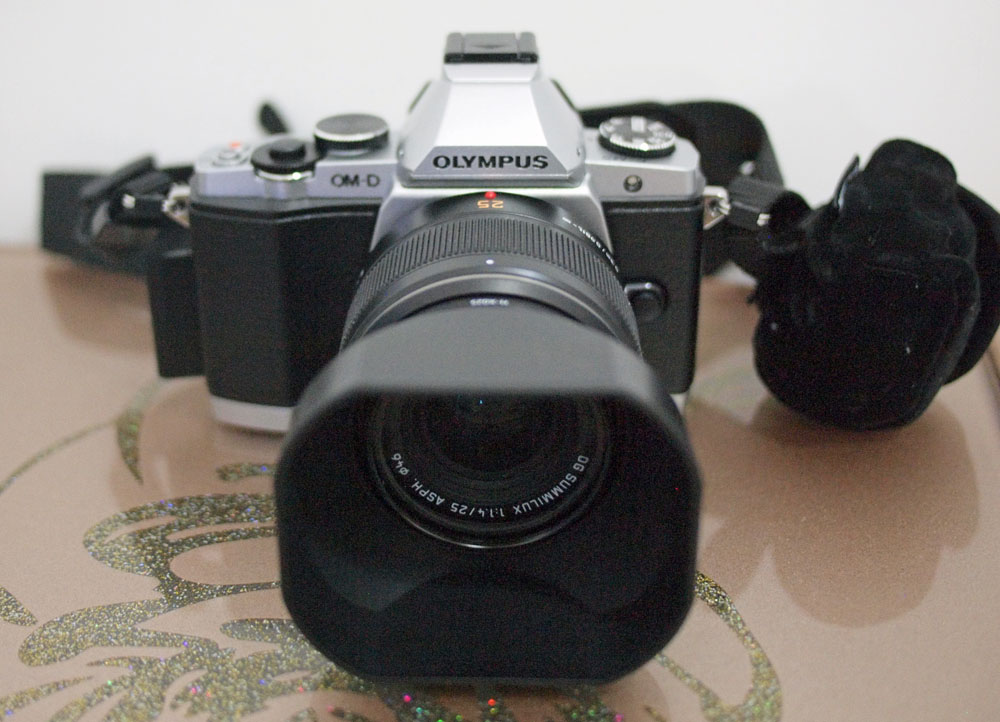
Here is the EM-5 with the Panny Leica mounted. In my opinion, the EM-5 is not as pretty as the E-P1 but being a 2012 model, it has many important advances over 3 year old technology.


The camera is so extensively customizable, it'd take me a week to effectively learn the control layout and optimize all the programmable settings.

Fortunately, a leading website dpreview.com has put together a 3 page guide to getting the most out of the E-M5, see here. 30 minutes later and a quick charge of the battery, I was ready to get my first shots.

The E-M5 is supposed to be vastly superior to the E-P1 in many different ways, but probably the most prominent are control of noise level for available light shooting and speed of autofocus (supposed to be the world's fastest as of 2012).

So, here are two images taken just after dark with the Panny Leica wide open at f/1.4. Nothing special in terms of composition, that'll have to wait for another day.


Small worlds

I've talked about taking table tennis coaching lessons with Crystal Huang at LATTA before, see - for example - prior posts too many degrees of freedom and structural reform.


Just this weekend I was in Shenzhen and visited a small-ish ping pong club that I've never visited before, called 大家乐乒乓球馆 (see picture above). It's a bit hard to find, being on the 3rd floor of a building behind another building, and co-located with a badminton club next door.

I took lessons on both Saturday and Sunday with coach Huang Lin Ling (黄琳玲) who co-owns this club.


At 100 yuan per hour, she is a more expensive and higher level player than any coach I've taken a lesson from before. She is a two-winged looper - backhand and forehand - and has a wicked backhand serve. Doesn't matter what you do or where you place the ball, she will loop it with devastating power from either side. (She was on the Chinese national team at the 2nd team level.)

Anyway, she was asking about how I got coaching in the US, and I mentioned my coach was also called Huang, Crystal Huang. But I didn't know Crystal's chinese first name. I said Crystal represented the USA at the Beijing Olympics.

Huang Lin Ling then proceeded to describe Crystal down to a tee, including forehand rubber choice. I was amazed. Turns out they were both of the same generation and teammates at the provincial level in Hunan (湖南). They knew each other well. Crystal emigrated to the USA as a teenager. Huang Lin Ling went on to the Chinese national team. It's really such a small world!

As I mentioned above, the club is rather small. It has two "wings". One contains a row of tables:


The other wing contains 5 individually barriered courts:


Although it's smaller than the South China club (世纪南华乒乓球俱乐部), see post here that my friend Liang Liung first introduced me to way back in 2009, the air-conditioning at this smaller club is much better, a major consideration given the heat and humidity of southern China in summer.

Sunday, May 13, 2012

Convocation


It's the end of the semester again. Here's a panorama from the front row of the College of Social and Behavioral Sciences (SBS) Convocation at the Tucson Convention Center (TCC) on Friday.

This reminds me of simply how large the university is. This event is just for SBS. And it's just one of the multiple convocation events being held at for the constituent colleges of University of Arizona as well as ones for the university itself. You couldn't possibly hold a combined graduation ceremony where everyone's name can be read out. Just isn't practical.

I attended, representing a small Master's degree program in Human Language Technology (HLT) that I run for the department of Linguistics.


Saturday, May 5, 2012

40 days, 40 runs


Run rabbit run

Dig that hole, forget the sun

And when at last the work is down

Don't sit down, it's time to dig another one

Did you know the number 40 has special significance across various cultures? For example, 40 is mentioned umpteen times in the bible. Basically, 40 has both a literal and an idiomatic meaning. More precisely, or perhaps less precisely, we can interpret 40 to mean "many of something" or simply "umpteen".

Today, my run streak has met its original goal of 40 consecutive days: a literal interpretation is intended in this case. At the outset, I said:
"Last 7 mornings, I've gotten up and run. I don't know how long this streak will last, but now that I've begun it, I'm tentatively hoping and aiming for 40 days in a row."
(See older posts: at the halfway mark 20 runs, 20 days, and after the first week 7 mornings, 7 runs.)

The goal was simple. Run a bit every single day. Enough to tax the cardio/muscular system, but not hard enough to impact one-day recovery. I should point out because of the shortness of the runs, this falls under "just exercising" (this can't really be considered training yet).

However, I set certain pace goals. On some days it was hard to begin never mind complete the workouts. For example, on days I worked late at the office, and felt dog-tired; at 11pm, I had to go out and complete the run before midnight. Other days, I didn't get enough sleep the day before or had done other significant exercise and still felt fatigued: in other words, I knew my legs were toast even before I started. Still, the very idea of keeping the streak going had "legs" of its own if you will. I persevered.

Almost religiously, I recorded all the runs into my spreadsheet:


Cumulative statistics are rather unimpressive. Just 165 km and 13,600 kcal burnt at an average pace of 5'07" per km for a total of 14 hours, 7 minutes and change. However, with an eye on my diet, especially during the 2nd half of the streak, I've managed to lose 2.5 kg (or 5.5 lbs). Another 1 kg and I think I'd be ready to start proper training.

As you can see by the chart below, the first twenty days were spent at the comfortable 7.0 mph mark (8'34" mile pace = 11.3 km/hr or 5'19" km pace) (when running indoors). As the spread of points show, by the end I was able to run for 40 minutes (or more) at that speed.


From day 21, I decided to up the speed on the Woodway Desmo treadmill to 7.5 mph (8'00" mile pace = 12 km/hr or 4'58" km pace). (This is not your ordinary gym treadmill, but an extremely expensive treadmill costing close to $10,000 that claims extremely repeatable and accurate speeds. Its slat design also feels very different from a belt-based treadmill.) I have to say running on a belt-based treadmill feels significantly easier than a Woodway at the same speed for some unfathomable reason. For example, I ran on a hotel Precor on day 33 at 7.5 mph. It felt as easy as 7.0 mph on the Woodway. This brings into question my treadmill runs from earlier years: for example before the 2010 Tokyo marathon, I was regularly running from 10K up to an hour at an indicated 13 km/hr on a belt treadmill at a Konami gym. And that was at sea level. What would be the Woodway equivalent at an altitude of 2400'(730m)? I have no idea.


Breathe, breathe in the air

Don't be afraid to care

Leave but don't leave me

Look around, choose your own ground

For long you live and high you fly

And smiles you'll give and tears you'll cry

And all your touch and all you see

Is all your life will ever be

0.5 mph (or 5'19" to 4'58" km pace) may not sound like much of an increment. But it put me over the edge. Threw me for a loop so to speak. Biomechanically, cadence and stride-wise, 7.5 mph felt quite different. Breathing also seemed like hard work. I could have stayed at 7.0 mph, but to improve, one has to explore the discomfort zone. It took days before I found the foot speed comfortable. Breathing took even longer. (This seems to make sense to me (a non-sports scientist): neuromuscular adaptation is probably faster than adaptation in the aerobic system.)

For example, on day 21, I ran for a planned 15 minutes continuously at 7.5 mph (after running continuously for 40 minutes at 7.0 mph the day before). However, I was unable to match this 15 continuous minutes at 7.5 mph (never mind build on it) until day 39. Some days, if I had trained for a couple of hours the day before, I could only manage 3 or 5 minutes at a time at that speed before being forced to take a short walk break. On days 39 and 40, I finally passed that initial mark on consecutive days.

Although I regard my 40 days as a minor achievement, I don't yet feel 7.5 mph is "my speed" on the Woodway Desmo. Therefore I've decided to continue the streak for one more week to see where it takes me.

Update: Actually, I only lasted 4 more days. Managed 20 mins straight at 7.5 mph on the Woodway on day 42 but broke on day 45. A low pressure system brought in dust storms, culminating in one that swept through Tucson at 75mph (120 km/hr). Triggered my asthma (from childhood). I was simply done: cut down to size, reduced to wheezing when climbing one flight of stairs to my office, only the twin miracles of Ventolin and Flovent preventing me from feeling like merely breathing through a straw.