Showing posts with label shenzhen ping pong. Show all posts

Saturday, February 4, 2012

A lesson with Crystal Huang: two left feet

This is the third entry in my continuing series about learning table tennis technique with Crystal Huang, a professional table tennis coach. These video clips were taken at the LATTA last weekend. (Previous entries can be accessed here: #2 too many degrees of freedom and #1 structural reform.)

Have you ever had the experience of attending an aerobics class at the local gym but came away discouraged, feeling utterly unable to follow the moves? If you understand what I'm referring to, you might empathize with me. If not, I envy your natural talent.

The video here will demonstrate that I am a particularly embarrassing example of two left feet. Since footwork is paramount in table tennis, this is a very big developmental challenge: a potential showstopper. In fact, it will become apparent that I can't even figure out a simple two point five step move even when it is repeatedly demonstrated right in front of me. Thank goodness for computer software, only when I viewed it frame by frame did the proverbial lightbulb go off in my head.

The specific challenge here is to move in correctly when the ball is played short to the forehand. Generally speaking, we have about 1/3 of a second to respond appropriately. Proper footwork is essential to getting in close enough to execute a decent flip, smash or push stroke over the table. Possessing a good stroke is useless without the necessary accompanying footwork. Rather like being all ready to ski without an appropriate vehicle to get you up the slippery snow-covered roads to that mountain that looks so good in the distance. Not sure that's the best analogy but, in table tennis, speedy footwork is needed to deliver us in about 2/10ths of a second close to where the ball bounces while retaining good body balance. And proper balance is needed to support good stroke execution and facilitate recovery.

Because this is all about movement, let's go to the video directly. We begin with the following drill:

Here the instructor stands at the top right corner of the diagram. The ball is blocked randomly to my backhand and forehand. I'm having trouble getting close to the forehand ball, especially when it bounces short near the net.

I have taken the liberty of adding commentary and translation where appropriate so you can follow Crystal Huang's instructional style. (For those who prefer to skip forwards, minutes 8:19-9:26 is where I'm utilizing the footwork in point play.) Also, since the video is a bit long, you might want to click on the "I" icon and set the resolution to 360p for a faster download.

Link: here

As should be clear from the video, my clumsiness resulted from my lack of understanding of how to perform the step, stop, step sequence. That is because I didn't understand what was really happening in real time. For those as translationally challenged as me, let me offer the following frame-by-frame explication. Thank goodness for video editing software.


(A)

(B)

(C)

(D)


(E)

(F)

(G)

(A) is the starting position.

In (B), body weight is shifted to the right.

This unweighs the left foot, which allows it to move towards the right foot, as shown in (C).

You can then stand on the left foot in its new position, and unweigh the right foot. This is shown in (D).

Then it's just a matter of picking up the right foot and placing it in under the table. This is exhibited by the sequence (E) through (G).

Notice the racquet arm does not move until (F) and (G). In other words, you don't backswing first and move later.

At (G), the weight is transferred to the right foot. Next, we need to lean the upper body over for reach when the ball lands short or close to the net. The left foot may go back a bit to counterbalance the torso lean. The free arm is often also used for this purpose.

Finally, one more critical point that may not be immediately apparent to some ping pong students is the fundamental idea to always pause momentarily and re-balance first after moving before hitting the ball. In this case, this would be just after the lean over from (G). That slight pause for balance makes all the difference in the world in making the push or flip stroke crispy (my terminology), i.e. much more effective.

If you need it, here is the video version of the frame sequence:

Link: here

Wednesday, February 1, 2012

A lesson with Crystal Huang: too many degrees of freedom

This is my second blog entry in this series about learning table tennis technique with Crystal Huang. For the first entry and a description of the motivation and goals of the series, see here.

The human arm is said to have 7 degrees of freedom. At the shoulder, we have 3 of those 7 degrees: up/down (i.e. pitch), left/right (i.e. yaw) and the ability to rotate (aka roll). The wrist is independently capable of pitch, yaw and roll as well. That makes 6. Finally the elbow has a single degree of freedom (pitch). So if you like, there are 7 positional parameters to the system.

When you perform an arm stroke, the number of parameters in the system multiplies. For example, we now have acceleration of the various parts of arm to take into account. Then factor in timing, and the position of the torso, center of gravity and feet placement. Add to that subtleties of ball contact and feel, and adjustment for the speed and spin of the incoming ball and where you intend to place the return, and you can see how sometimes it's difficult it is to reproduce a stroke even when we have it demonstrated for us up close and live. Anyway, that's my excuse for being a poor learner.

In the following video, I'm trying to learn a new forehand push stroke. The idea is to be able to receive the underspin (or sidespin) ball with the forehand side of the racquet, control and send it to different positions on the table reliably. I already have a forehand push I've been using for years, it's just not a good one.

The day before the video was recorded last weekend, I had about 15 minutes of instruction on the new stroke. Unfortunately, I confess I didn't truly "grok" or properly understand how the stroke should be executed. Even having the correct stroke demonstrated to me didn't trigger how it should feel. I was still not executing it well.

As this video clip shows, Crystal (after shaking her head) ended up coming around to my side of the table and moving my arm for me. This reduces the number of degrees of freedom of the arm to zero. And only then did I really understand what the stroke should feel like.

The video also contains captioning that I've added of Crystal's instructions during the session. This might be of interest to other table tennis students.

The video clip ends with me using the new forehand push to return service to different parts of the table. And then playing out the point.

Link: here

Tuesday, January 31, 2012

A lesson with Crystal Huang: structural reform

This is the first of a long series of posts about improving my table tennis. This is not about beautiful technique. There are plenty of videos on youtube for that. It's about my struggle and probably quixotic quest for better technique. More precisely, it's about structural reform. In other words, engineering out already-learned but ultimately flawed and limited strokes. Undo, then redo. The goal is to override muscle memory and replace with better programming.

Structural reform is a term I hear a lot nowadays: especially, with respect to the current eurozone crisis. Old habits die hard but countries have to change their ways. Growth, if possible, is the preferred way out. If not, austerity to shrink the economy is the only option left. Seems like it's either grow or wither away and lose maybe decades.

The same seems to be true in table tennis. We have a few tenths of a second (usually around 1/3 of a second) to react to the incoming ball and do something about it. Therefore, a lot is dependent on muscle memory. Human muscle memory is reliable and responses can be deployed almost without conscious thought. This is all and good given proper training and conditioning.

Unfortunately, some amateurs such as myself, without someone to nip flaws in the bud so to speak, spent years hitting balls incorrectly. This not only looks bad but also limits performance. After improving muscle memory through repetition, the amateur improves until he/she plateaus, unable to break through to the next level no matter how often they practice.

The next logical step then is to employ a professional coach who can highlight weaknesses and point the student in the right direction. A good coach can both demonstrate proper technique and explain why and how to execute the proper stroke. Unfortunately, the amateur has spent considerable time "grooving" his strokes and that subconscious muscle memory that enabled him/her to respond in 1/3 second is now a huge barrier to change. Reprogramming muscle memory is incredibly difficult.

The amateur then rues not employing a proper coach from the first day he/she picked up a paddle. Short of being reborn and learning proper technique under close supervision as a child, the amateur faces a long and frustratingly difficult road in overcoming his initial self-learning or natural programming. Watching videos of world champions with beautiful technique doesn't really help. The gap is too large. Even seeing what seems like humanly possible proper technique up close and live, subtleties escape the observer and attempted replication results in just a pale and unreliable facsimile of what he/she just saw.

The amateur may be missing crucial knowledge. But even possessing the correct knowledge doesn't seem to help as much as he/she thought. Low level programming seems unavailable or strangely elusive to conscious thought processes.

On this beautifully sunny past weekend in Los Angeles, I decided to spend 15 hours indoors at the LATTA to take lessons with Crystal Huang, a professional who went to the Beijing Olympics on the USA national team. Retired from competition, she is a coach. (I've blogged about the club before here.)

I decided to get more serious about structural reform, so I recorded a lot of video over a weekend. Just merely taping a coaching session doesn't really do much. So I started editing the videos into clips to remind myself of what to do (as well as what to not do). It became a labor intensive process because I found myself adding captioning as an aid to understanding. So I thought I might as well share. Perhaps some of these may be of use to others, spark a change or two, or at the very least make the reader feel thankful their game doesn't include my huge set of flaws.

Next time, we'll look at how Crystal tries to point out and correct my many flaws. This time, I'd like to show how even the warm-up (before the lesson truly begins) can be very revealing.

This first video is of my forehand block. Crystal is gently topspinning (or looping) the ball to my forehand. The rate is almost exactly 1 ball per second. I know precisely which quadrant the balls will fall in. In fact, I only have to worry about blocking that ball diagonally back to her forehand (she is a lefty). I block the ball back 33 times consecutively in the following clip but, as you can see, I still manage to screw things up.

Link: here

The fundamental problem is I'm not constantly moving to track the ball. I'm reacting too late (ball is about to arrive), and having to move off-balance and attempt to correct and rebalance in record time. By block #34, I've lost track of my center of gravity and clearly it looks rather ugly.

Slow motion of block #15 is rather revealing and will make the problem clear. See captions in the clip below.

Link: here

Tellingly, because I had to lunge I was unable to block the ball back to her forehand corner. Instead, notice the ball went to the middle of the table. You may not have noticed that she smoothly moved across and still looped the ball to my corner so I could continue.

Here's what went wrong.

(a) (b) (c)

In (a), the ball is looped. I haven't yet noticed the ball will end up out of reach. (I should have observed the angle of the paddle and reacted by shuffling to the right. In fact, it's critical I do so.)

In (b), 0.26 seconds later, the ball is landing on my side. Too late, I realize it's out of reach. I've wasted 0.26 seconds without moving my feet.

In another 1/10th of a second, I lunge with my arm as the ball arrives. Although I get to the ball and return it, it's just a mere band-aid. Actually, the situation is quite dire.

As a result of the lunge, I'm way off balance as shown in (c). Instead of sensibly moving sideways to the right earlier, now I've created an unnecessarily enormous backlog of work for the next 0.6 seconds.

I have to land away from the table, regain balance, push off again and hop back towards the centerline, rebalance myself and hope I get there before the ball arrives again. Despite the leisurely 1 second interval between balls, I barely got back in time.

And of course, my mistake is actually deadly in practice. Had the drill been not just to my forehand, the ball could have been looped to my backhand corner. In that case, there is no way in hell I could have gotten back in time of course.

A keen observer will notice there are other systemic problems that I haven't mentioned. For example, notice I automatically drop my arm after each block. This is another very bad habit that will cost valuable tenths of a second.

Friday, May 6, 2011

Shenzhen Ping Pong: LATTA

Travel by itself can be cathartic, bringing about a genuine realignment in perspective.

I am just a dreamer, but you are just a dream...

One of the things that can make us better and more accomplished human beings is a sense of passion, and an accompanying desire to succeed. As with life and perhaps so with athletic goals.

It can start with a simple dream, a realizable goal and the determination to make it happen. On one hand, having a concrete goal allow us to set milestones along the way and measure out progress. On the other hand, despite the application of plenty of sweat and fitness, goals can remain tantalizingly out of reach and lead to pent-up feelings of frustration when things aren't working out right.

With respect to catharsis, it has been said that it is the human soul that is purged of its excessive passions. Experiencing these moments could be a good thing.

It's a good seven hour drive from Tucson to the Los Angeles Table Tennis Association (LATTA), a straight shot on Interstate 10 heading west all the way out to the Pacific ocean. I took the opportunity to use up a furlough day. Loaded the car up with a couple of boxes of water and gatorade. Throw in my gym bag and an extra bag full of ping pong clothing. I'm gonna focus on eat, sleep and play ping pong, nothing else I need to bring along. Plug the iPod into the car stereo. Turn up the volume. Set the cruise control and satnav. Relax. Seven hours each way is a lot of time for the brain to unwind and reorganize.

The LATTA is the largest table tennis club in LA with professional coaches. Like many marginal sports, at first glance, the facility is nothing much to look at. One could easily pass by and not notice it. Simple signage leads to a warehouse facility.

Hmm, I guess I can do better than that. Here is a photo at sunset when people are actually present at the club.

Inside, we have high ceilings, quality table tennis tables, barriered areas, and a professional (red) rubber floor.

I have to say the lighting is not quite as good as it might be, perhaps I'm spoiled at my ping pong palace with indirect lighting. Also, most courts there are not individually barriered. But the last point/feature about the floor is important to me. Playing on concrete is simply really tough on joints. And concrete and other surfaces (even wood) can be slippery unless kept very clean. But putting aside facilities, the single most important fact is simply there are lots of good players who frequent the club. And that's why I'm here.

Catharsis

Anyway back to the theme of this blog entry, this rather unassuming but friendly and generous lady is Zhu Min Ming, originally from Guangzhou. She told me she is rated around 1600. She beat me 2-0 first day I arrived. I figured perhaps I was a little tired after a seven hour drive plus taking two hours of coaching.

Well, by last day, when I thought I was pretty grooved in, although I had my moments, she beat me 2-0 again deservedly.

And when she told me I was playing 1700 level, maybe at most 1800, it was definitely a cathartic moment. To learn to win one has first to learn to handle one's weaknesses. To learn to handle one's weaknesses one first has to learn how to lose.

( I'm sure I'll eventually get used to her close-to-the-table game with smooth rubber on one side and semi-long pips on the other.)

Equipment

I also got the opportunity to meet Hideo (from Orange County) in person. He came on Saturday to play the Round Robin at LATTA.

Hideo frequents the same online ping pong forum as me and was kind enough to mail me one of his modified paddles to test last month. (See below.)

Despite its compact appearance, the grip is similar to my thumbgrip-modified SuperCPen in feel (see here). However, due to the wood used in the construction of the handle, it's significantly heavier and slower than my modified SuperCPen.

Coaching

And now to the main purpose of my LATTA sojourn, although one can theoretically get coaching from any professional, I've always wanted to get coaching from a top-level penholder who understands the reverse penhold backhand.

Crystal Huang (rated 2460), who runs the LATTA, is a former member of the US Table Tennis team; in fact, she represented the USA at the Beijing Olympics in 2008. Since she is an expert penholder, I've been taking lessons on the penhold style from her.

Given I'm in the progress of overhauling my game completely (from my previous one-sided traditional penhold technique), I'm kinda retooling from scratch, and therefore need to learn to lose not just all the old bad habits, but need to learn to lose by bravely adopting the weaker but theoretically better strokes in matches - at the cost of losing matches I could have won using unfortunately well grooved-in but theoretically inferior strokes. In other words, accept short-term total humiliation with the prospect (possibly unrealized and unguaranteed) of better things to come. I admit this has been hard. That is why creating the necessary conditions for catharsis is required in order to break that logjam. Thank you Zhu Min Ming!

As the beginning of this post states, I'm just a dreamer and you are just a dream... Forever dreaming only if I could work out how to move, stay balanced and hit a decent forehand... Well, dreaming is free but lessons are not. Onto the videos...

Video Clips

[Seems strange, I lost my earlier edits to this post.]

As I've mentioned in earlier posts on the topic, my forehand is one of those strokes I've had fundamental problems with but have always wanted to fix. On the one hand, my forehand loop is powerful (for my level) and wins me many points. On the other hand, it needs to be abandoned totally and radically restructured if I am to make any progress. The following warm-up with Crystal Huang illustrates many of the problems I have with the stroke.


Link here

More sample video clips to follow...

Wednesday, April 27, 2011

Shenzhen Ping Pong: SuperCPen S

This is the final installment of my series on experimenting with the SuperCPen concept.

Due to some morphological and possibly stroke-related issues with the SuperCPen handle width (56mm), I recently had a Butterfly Innerforce ZLC penhold blade re-converted into SuperCPen size S (44mm wide). The blade weighs 78g (without rubber).

I can report that the SuperCPen size S seems to fit my hand much better than the regular SuperCPen handle. Unlike the full width version, I can hold it comfortably for an extended amount of time. This could be because my hand is smaller than what the regular SuperCPen was designed for.

For relevant prior discussion, see previous blog post here

Anyhow, let's go to the video!


Link: here
(Thanks to Jeff Duan, practice partner.)

Compare the strokes above to the video clip in the prior post using the thumbgrip-modified SuperCPen (see link here. Can you detect a difference in the strokes?

Observations

Generally, I seem to cope better with the SuperCPen S than the full SuperCPen. However, I have noticed two tendencies which doesn't seem to forebode well:
  1. I get index finger creep, i.e. my index finger seems to want to move up the handle as I play. This puts undue pressure on the first joint of the finger and causes some pain.
  2. When I cock my wrist back for the reverse backhand, my wrist feels strained and occasionally it hurts when I execute the wrist flick.
None of these symptoms occur with the thumbgrip-modified SuperCPen that I have been using. It could be simply that I'm fighting the blade in the sense I want to adjust how I hold the handle rather than adjusting my stroke to suit how I hold the handle. I may need to go slow on the SuperCPen S if I am to avoid an overuse injury.

Thursday, April 21, 2011

Shenzhen Ping Pong: Modified SuperCPen

It's always interesting to try innovative ideas. Recently, I have been experimenting with a SuperCPen handle for the penhold grip. As the picture shows, the handle is extremely wide (60mm).

Unfortunately, for various reasons I've been unable to get to "grips" - so to speak - with the SuperCPen grip (at least so far).

(See blog entry here for the details.)

With respect to the SuperCPen experiment, I had two paddles, a Butterfly Amultart and an Butterfly Innerforce ZLC, converted to the original 60mm wide grip. (I sent the Innerforce back a second time to be converted into SuperCPen S(small).)

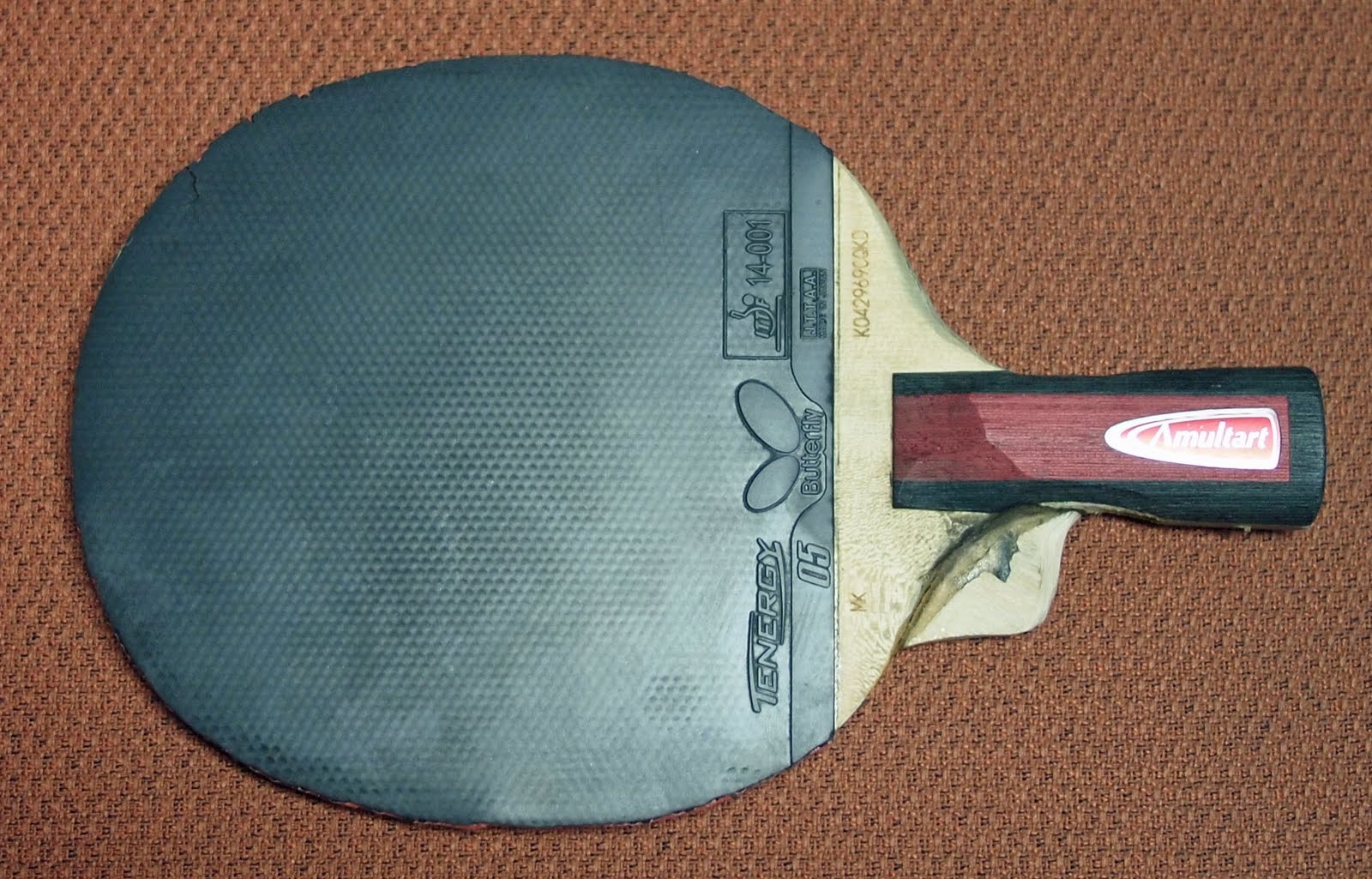
I decide to reshape one of these, the Butterfly Amultart SuperCPen, back to a regular Chinese penhold handle but with a built-in or integral thumbgrip. As shown in the picture on the right, I accomplished this by removing part of the wide SuperCPen handle to accommodate the thumb. As the scale indicates, one welcome side effect is that the reshaped paddle is actually much lighter than the original handle because, despite appearances, the modified SuperCPen handle is actually lighter than the stock penhold handle.

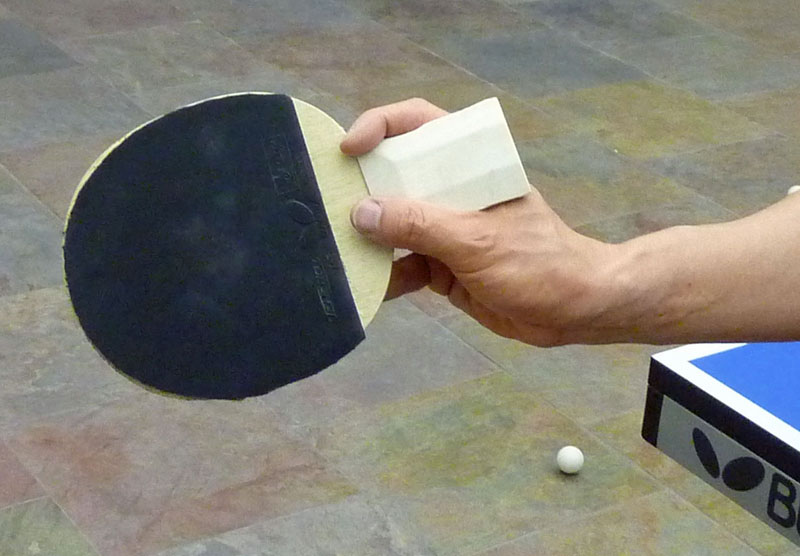
I had initially tinkered with the idea of adding a thumbgrip for Chinese penhold by simply using a piece of wood epoxied to the stock handle.

The idea behind the thumbgrip is that it provides additional grip surface area and stability for executing reverse backhand strokes. In my opinion, it is an improvement on the standard Chinese penhold handle for those who want to use a non-traditional backhand stroke.

(See blog post here for the details.)

Here is how I hold the modified SuperCPen blade:

I use Tenergy 05 black on the forehand and Tenergy 05 FX red on the backhand.

How does it feel and play?

Well, it certainly feels pretty good in my opinion. The handle is extremely comfortable: the back of the SuperCPen is wide and flat and has a cork backing. My index finger can comfortably wrap around the front part of the handle. And the thumb has great support. The wrist can turn quite freely (nearly as freely as with a regular Chinese penhold handle). No morphological issues at all.

As to how it plays, well here is a video clip:

Link: here
Thanks to Moy Yu (practice partner on the far side of the table).

Monday, March 21, 2011

Shenzhen Ping Pong: SuperCPen

Recently I've been tinkering with a traditional Chinese-style penhold blade to better support the reverse backhand I've been learning and practicing with. (See here and linked posts therein.)

Attempting to improve my reverse backhand further, basically, I took a regular Chinese penhold blade and epoxied a thumb grip for stability and power for the backhand loop and over-the-table backhand wrist open. (You can see the epoxied support in the picture to the right.)

Details of that experiment can be seen here. Initial indications were very encouraging.

SuperCPen is Dai Feng's idea. (See his website here.) He offers a more much professional-looking solution. And to my eyes, it's a considerably more labor-intensive and adventurous modification than my humble experiment.

He had mentioned to me that he had tried something like a thumb grip before, so I was very curious to see how far Dai Feng had taken the concept.

I was also intrigued about what his modification has to offer someone like me who has been training for the reverse backhand, but also occasionally use the traditional backhand. Moreover, although I don't have any grip problems with the forehand, an improvement there would always be welcome. So I ordered and sent him a brand-new Butterfly Amultart to modify.

[The traditional backhand still offers an advantage for certain common situations in game play. If the ball is looped to your forehand/backhand crossover point, if the incoming ball is a surprise, it's possible to react faster with a traditional block because there is no crossover point.]

I've never seen a paddle quite like it. (See the picture on the right.) Its sheer width and large surface area permits support for the thumb, and also allows maximum surface area contact with the index finger and the fleshy part of the hand between the thumb and index finger.

It also cut a 10g off the blade weight; doesn't sound significant but percentage-wise, that's quite a change: 86g down to 76g.

The thumb achieves its support by rotating the blade in the hand until the thumb contacts the middle or centerline of the new handle. This re-angling of the blade makes the SuperCPen concept unique.

[To get an idea of how different: compare the placement of the thumb here with that of the first picture above.]

By comparing the SuperCPen picture above to the initial pictures below, you can see I've shaved away some material from the beveled top to provide a large, flat angled area for the thumb. (I've also removed a bit of material from the index finger side since I got a blister first time I played with the SuperCPen.)

In contrast to the beveled top, the reverse side is completely flat with a cork sheet glued for good grip.

Initial impressions? Well, I don't have any problems with the traditional Chinese grip. And my thumb modification already improved on that for the backhand, so I didn't expect that much more from the SuperCPen. But what about the forehand?

I've only had the SuperCPen for a weekend. I did some ball drills with it. And I played a few matches, switching back and forth between the SuperCPen and a traditional blade nearly every game. My impressions? It's early days yet but here you go:

Pluses:
  • It's definitely good for the reverse backhand stroke.

    Stability is assured. Removing some of the beveled top surface seems to provide a flat thumb area seemed to improve it further. Compared to my thumb modification, the SuperCPen is as good (or better).

  • You gain leverage for power on both sides. Your wrist ends up further away from the blade. A bit like the effect of a longer handle.

Minuses:
  • Over the table backhand topspin/sidespin flick, the traditional block, and the reverse side small counterloop are definitely not as good.

    The simple reason is that I cannot achieve the same rotation as easily with the wrist.

    It could be a lack of wrist flexibility with the SuperCPen or the fact that the wrist rotation point is further away from the ball contact point: the "long lever" effect. You can easily test your wrist flexibility by closing the distance between your index finger and thumb to zero and then cocking the wrist back. And then check that against having the thumb and index finger further apart. There is a significant difference in my opinion.

    Mitigating against this: let me point out there is a rudimentary video on Dai's website for the "wrist turn" backhand, and also documentation for a "control" grip.

  • As for the forehand loop, I found the SuperCPen a bit awkward. Grip was solid, but as I mentioned earlier, I don't have any grip problems with the regular Chinese-style blades. No net improvement felt.

  • Push. I found I had less control with the push due to the long-lever effect. I didn't experiment with switching to the control grip just for this shot.

  • Serve. Inferior experience due to less wrist flexibility with the SuperCPen.

I'd like to emphasize that some of these problems may go away with more playing time as I adjust to the angling imposed by blade. (Also, my wrist became fatigued after about an hour.)

[Clearly there is some adaptation involved. Initially, I was losing games against the (same) opponent with the SuperCPen that I was winning with a regular Chinese-style blade. Towards the end, I was able to win with it too but not to the same comfort level.]

For comparison, here is the SuperCPen and my modified blade side by side:

[Ignore the short pips rubber illustrated above. I don't use short pips. I loop with Tenergy 05.]

And my modified blade superimposed on to of the SuperCPen.

Update

I felt the grip was rather uncomfortable and I never got really used to it. So I converted the Amultart SuperCPen into a paddle equivalent to the thumbgrip Amultart shown earlier in this blog entry. Meanwhile, I sent Dai another new paddle, a Butterfly Innerforce ZLC to be modified into a SuperCPen.

After a week or two playing with the Innerforce ZLC SuperCPen exclusively, I managed to hurt my index finger (bruise near tip and first joint pain). It eventually became too painful to stroke freely and overcompensation gave my wrist a bit of an overuse injury too. I stopped and went back to the thumbgrip-modified Amultart SuperCPen. Before stopping, I shaved the SuperCPen down to 50mm width to see if that helped. Unfortunately, I still had problems executing my strokes without pain. There could be morphological reasons for this.

For posterity, here is my last video with the SuperCPen executing the reverse backhand (in some pain):

The positioning of the fingers on the SuperCPen:

When I went back to my thumbgrip paddle, the index finger pain went away almost immediately, and the wrist felt under less strain.

At the time of writing, I am playing with the thumbgrip paddle (which plays conventionally but with better grip) and have sent the Innerforce ZLC SuperCPen to be modified into a SuperCPen (size S) - which was not available at the beginning of this experiment. When my injury is healed, I will try the Innerforce ZLC SuperCPen S. Meanwhile, I will try to re-discover and re-balance my strokes with the thumbgrip paddle.

Thursday, February 17, 2011

Shenzhen Ping Pong: reverse penhold paddle

In this blog entry, I'd like to return to consider the topic of the penhold grip, first introduced here.

There are two basic styles of penhold blades: Chinese (round head, flared handle) and Japanese (rectangular head, built-up cork handle with a hook for the index finger). The Japanese blade favors a powerful forehand loop and the Chinese blade perhaps provides for a more flexible wrist in over the table play. Recently, there also has been some interest in developing blades that favor the reverse penhold backhand stroke. The picture on the right shows a penhold blade that I've modified for this very purpose.

Some background first. I've been blogging about the reverse penhold stroke for a while now: for example, see entries in December 2010, Feb 2010 and October 2009. The videos show that my reverse backhand stroke has evolved over the course of this time period (and is still evolving). Learning a brand-new backhand isn't easy, especially if you want the new reverse backhand to dominate and supercede the traditional backhand, a stroke developed over many years.

There are claims that new grip designs can make the reverse backhand stroke stronger and more consistent. For example, one can convert an existing blade, as in the SuperCPen design here), or build a blade from the ground up, as in the Gushi penhold blade (古氏直拍) (here).

Interested in improving my reverse backhand, I purchased a Gushi blade to see what the fuss was about.

It has an ingenious cut-out in the handle and an extension to the head to allow the thumb to rest comfortably horizontal with good support. Unfortunately, the Japanese-style blade weigh 106g (vs. about 86g for my current blade), and the blade itself is much slower than my preferred Butterfly Amultart. The extreme weight (for a penhold-style blade) meant I could only hit for about 10 minutes before fatigue set in. In short, I believe the Gushi cannot hold a candle to my Amultart blade; nevertheless I determined that its idea of supporting the length of the thumb had definite merit for grip stability, and consequently the power and reliability of the reverse backhand stroke. If only I could try an Amultart Gushi...

Someone suggested the possibility of epoxying a thumb grip (weighing 8g) to a regular penhold blade. Before modifying the rather expensive Amultart, I tried adding a rough thumb grip (sourced from wood scraps from a guitar maker) to an old Sword blade. However, the epoxy attachment wasn't secure, and thumb lever force made it fall off after about 10 mins of reverse backhand play. But the concept seemed sound.

I then took a Dremel tool to the thumb grip and reshaped it to custom contour it to the Amultart blade and the length of my thumb. And employed an excess of epoxy to fill in any gaps to make sure it could withstand thumb lever force. Result is shown below:

Front and back:

In the hand:

For me, the extra thumb grip is a definite enhancement to my Butterfly Amultart blade. It's early days yet with the modification, but I can feel my reverse backhand is considerably more stable, powerful and reliable.

Acknowledgements: Many thanks to Jiwu Duan and his guitar-maker friend for making this project possible!

Saturday, December 25, 2010

Shenzhen Ping Pong: Li Jun at the Pacific club

In this increasingly homogenized world, minority styles are at a premium. For example, it's really difficult to find good choppers to loop against. Therefore this winter break, I was grateful for the opportunity to hit with Li Jun (李君) at the Pacific club while visiting Shenzhen.

She is a high-level chopper with Friendship 802 short pips with thin sponge on the red side (backhand) and inverted on the black side (forehand). Having resided in Belgium for a while, she speaks English (some Flemish as well) and understands my Cantonese. (I don't speak Mandarin unfortunately.) She was also ladies singles champion while in Belgium.

The so-called Pacific club, is officially called the 友傳乒乓城. It is conveniently located near the Mix City (万象城) shopping area in Luo Hu (罗湖). However, people know it as the Pacific club because of the name of the building in which it resides.

It has excellent air-conditioning (necessary for humid and hot summers in Southern China) and a range of court sizes. The cost (aka table fee) for one of the larger individually barriered courts ranges from around 40 to 55 RMB an hour: actual price depending on peak/off-peak demand. Of course, a large court is needed for the chopping game. (For comparison, an individually barriered court at the Shenzhen Century South China Table Tennis Club (深圳市世纪南华乒乓球俱乐部) that I've blogged about previously costs from 20 to 38 RMB per hour.)

In addition to the table fee, one must pay the coaching fee. In the case of Li Jun, she charges 100 RMB per hour. A reasonable practice session would range from 90 minutes to 2.5 hours. One needs about 20 minutes to warm up. And then looping 4 or 5 baskets of balls will take up the rest of the 2 hours. You can do the math.

First, let's warm up the forehand.

(Direct link to the video here.)

And then, the reverse penhold backhand.

(Direct link to the video here.)

As to be expected, you can probably see that my reverse penhold stroke has evolved a bit since my previous posts on the topic. (I may take the opportunity to blog about the technical changes involved next time.)

Finally, we are ready to loop for an hour or two. First, looping on the forehand diagonal.

(Direct link to the video here.)

Some background is appropriate at this point. I first learned to loop with short pips a long time ago. Despite switching to inverted at 1900 level, and progressing to a pretty solid 2100 rating years ago, the underpinnings of that loop with all its warts visible here (which currently hold me back) can be traced back to my first short pips experience.

In short, I'm attempting to dump and re-tool my forehand loop. (Yes, I want to get rid of that same loop stroke that got me over 2000.) However, years of inappropriate reinforcement has meant that change has been particularly hard to come by without impacting power and spin in a major way. In particular, the ingrained timing and over-large backswing that I have developed has been a barrier to progress. It's gonna take a lot of effort to re-program my muscle memory. Looping against chop is an excellent way to overwrite that muscle memory.

So on this visit, my plan was to play Li Jun every other day. This gives sufficient recovery time and also time to review the recorded video, and think about stroke changes. Since her chop is pretty high level, one must be able to loop a pretty strong ball even to put it on the table, and definitely a very strong ball if it's to challenge her chop. So there always pressure on the the looper. And under pressure, I tend to revert to old habits that die hard. Still, one must swim against the current sometimes... in order to spawn something better...

Tuesday, December 7, 2010

Shenzhen Ping Pong: the penhold grip

In table tennis, the penhold (or spoon) grip is the less common of the two major ways in which to grip the paddle. The self-descriptive shakehands grip is dominant in modern play. Shakehands offers particular advantages for two-winged attack that the traditionally one-sided penhold grip lacks, requiring instead excellent footwork to compensate.

However, in the last couple of decades, innovation in the form of the reverse (side) backhand has allowed modern penhold to compete with the backhand loop of the shakehands grip. In previous relevant entries in this blog, I have documented my attempts to acquire that reverse penhold backhand.

I (un)lucked into the penhold grip by accident. Many decades ago, someone with good intentions gifted me a Chinese-made, one-sided Double Happiness penhold paddle of the kind sold in department stores. It had short pips-out rubber on one side and merely painted wood on the other. Because of a grip size difference, blades for penhold and shakehands also typically have different handles: in particular, penhold handles are too short to hold comfortably with the shakehands grip. As they say, the rest is history: I'm stuck with penhold.

An interesting fact about the human wrist joint is that it has a remarkably limited range of motion. The wrist is really only capable of a limited amount of natural rotation (relatively unstressed) about the cylindrical axis. You can rotate the hand relatively far clockwise but not very far at all anticlockwise (without co-opting the elbow). The hinge at the base of the palm allows the hand to tilt (or "cock") forwards or backhands in addition to the rotation. Furthermore, it's abundantly clear that there is considerable variation in the degree of flexibility exhibited by different players. Small changes in how one grips the paddle can mean large differences in available paddle angle. And differences at the wrist can require (undesirable) larger compensatory differences at the elbow and shoulder. A little sad perhaps, but I can safely report I made it from absolute beginner to 2100 level in the 1990s without really knowing how hold a penhold paddle properly.

Although improvements have been forthcoming, I still cannot state with certainty that I know how to hold the paddle correctly. Having said that, I believe the correct way is to grip the paddle between the thumb and the back three fingers. Obviously, the handle fits in the valley between the thumb and index finger (section 2). But aside from that, a range of subtle but significant adjustments seems possible. The index finger is free to close around the handle or relax and slide away from the center of blade, therefore widening the grip to achieve a more vertical paddle angle when the reverse backhand is deployed. Straightening the back fingers a bit (at least the middle finger) also seems to help with the reverse block/punch stroke. Rotation of the wrist clockwise about the cylindrical axis of the forearm is also critical to helping keep the reverse penhold open and aligned parallel to the table endline. (Otherwise, it seems the natural resting angle points perhaps 45 degrees too far to the right.) In terms of the forehand stroke, straightening the back fingers seems detrimental to a natural followthrough and therefore achievable power. (I find its effect can be felt as awkwardness at the elbow.) One must either fix on a compromise position or be able to execute subtle shifts in finger positioning on the fly. Experimentation is necessary, plus (as I mentioned earlier) some people have much greater wrist flexibility than others.

As for the paddle, the Chinese handle itself seems largely standardized between manufacturers. (The Japanese/Korean and twiddler penhold handles are another topic entirely.) I have made some measurements with calipers that seem to confirm relative standardization. Comfort and fatigue are especially critical issues for reverse backhand penholders who need to put rubber on both sides of the paddle. The resulting paddle is oftentimes nearly as heavy as shakehand paddles, despite having a shorter handle.

For example, here is the Chinese-made Sword blade I've been playing with since I resumed the game until very recently. I find this handle extremely comfortable with minimal customization. It weighs about 188g complete. Only change has been to smooth the sharp edges at the neck of the paddle on both sides. Of course, comfort is individual, given possible variation in hand size.

I recently switched to a Butterfly Amultart blade. This blade is heavier and much faster than the Sword. I weighed two samples at 94g and 90g, respectively. Incidentally or not, it seems to partner Tenergy 05 extremely well (as long as one has the skill level to handle the extra speed, somewhat debatable given my circa 2100 level of play). Outwardly, the unmodified handle is dimensionally extremely similar to the Sword but I found it "too big" and strangely uncomfortably.

After a few weeks of trying to get accustomed to the Amultart blade, I had to carefully modify the handle (over a period of several days) using a Dremel tool to "thin" the center section down to 25.4mm to comfortably accommodate the knuckle area (shown as section 1, top picture) and thumb. I also had to "scallop out" the underside of the handle (for section 2, top picture). Initially, I was puzzled by this. But experiments with an identical Butterfly handle with a thinner center section confirmed to me that the extra core thickness of the Amultart blade was responsible. We're talking just a few mm, but the differences in grip feel substantial and significant. (Incidentally, that other blade was a penhold Innerforce ZL Carbon, which is lighter and plays slower than Amultart, but seems to be another stellar offering from Butterfly.)

Modifications are shown in detail below (1: top/side, 2: top, 3: side, 4: underside).

Note: I have included a small cut out for the thumb on top of the blade.

Update

There exist penhold blades with special handles designed to facilitate use of the reverse backhand. I am grateful to those who brought my attention to the Gushi (古氏) and Sanwei (三维) designs below.