It's always interesting to try innovative ideas. Recently, I have been experimenting with a SuperCPen handle for the penhold grip. As the picture shows, the handle is extremely wide (60mm).
Unfortunately, for various reasons I've been unable to get to "grips" - so to speak - with the SuperCPen grip (at least so far).
(See blog entry here for the details.)
With respect to the SuperCPen experiment, I had two paddles, a Butterfly Amultart and an Butterfly Innerforce ZLC, converted to the original 60mm wide grip. (I sent the Innerforce back a second time to be converted into SuperCPen S(small).)
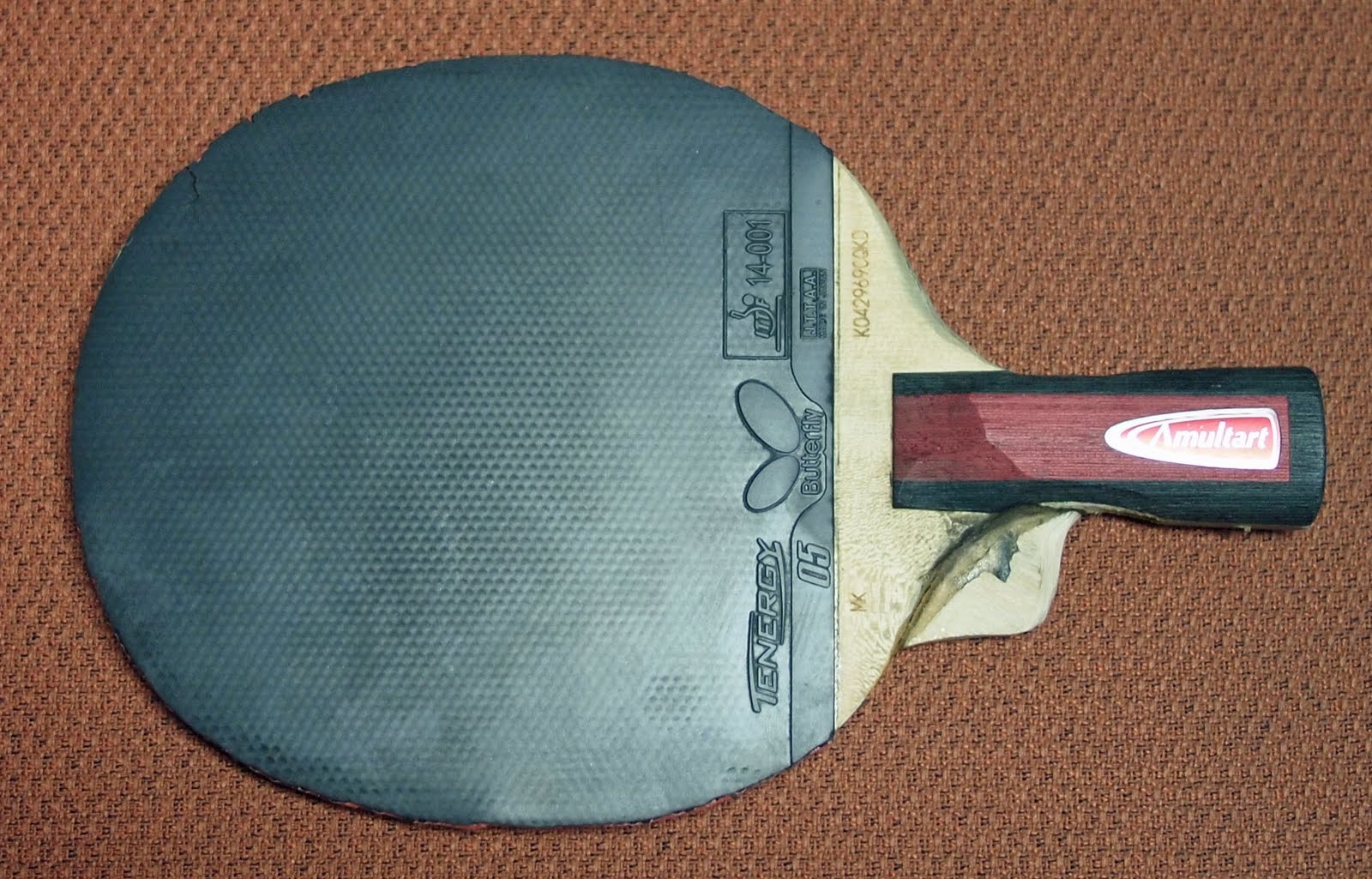
I decide to reshape one of these, the Butterfly Amultart SuperCPen, back to a regular Chinese penhold handle but with a built-in or integral thumbgrip. As shown in the picture on the right, I accomplished this by removing part of the wide SuperCPen handle to accommodate the thumb. As the scale indicates, one welcome side effect is that the reshaped paddle is actually much lighter than the original handle because, despite appearances, the modified SuperCPen handle is actually lighter than the stock penhold handle.
I had initially tinkered with the idea of adding a thumbgrip for Chinese penhold by simply using a piece of wood epoxied to the stock handle.
The idea behind the thumbgrip is that it provides additional grip surface area and stability for executing reverse backhand strokes. In my opinion, it is an improvement on the standard Chinese penhold handle for those who want to use a non-traditional backhand stroke.
(See blog post here for the details.)
Here is how I hold the modified SuperCPen blade:
I use Tenergy 05 black on the forehand and Tenergy 05 FX red on the backhand.
How does it feel and play?
Well, it certainly feels pretty good in my opinion. The handle is extremely comfortable: the back of the SuperCPen is wide and flat and has a cork backing. My index finger can comfortably wrap around the front part of the handle. And the thumb has great support. The wrist can turn quite freely (nearly as freely as with a regular Chinese penhold handle). No morphological issues at all.
As to how it plays, well here is a video clip:
Link: here
Thanks to Moy Yu (practice partner on the far side of the table).
Several thousand years ago, the Roman poet Juvenal wrote "orandum est ut sit mens sana in corpore sano" from which we derive that now famous quote about a healthy mind in a healthy body.
For a variety of reasons, recently, I confess I have kinda let my body and fitness slide.
This has become unacceptable. Not from reasons of vanity: it's not just about the physical,
there is a mental cost component as well. Mentally, I've noticed I've slid a bit too.
Of course, we all know there is a strictly limited number of hours available in a week. So, one of these reasons is purely a resource limitation. It's easy to crowd out time for physical recovery. I should know as a cyclist who used to train systematically with a powermeter, getting stronger is a feature of recovery, not the actual workout. Spacing the workouts out appropriately is crucial.
Trying to recapture my halcyon New Jersey ping pong days of a decade or more ago, I've concluded I've gone a bit overboard. This has crowded out basic fitness. I find ping pong somewhat frantic and mentally challenging. I love a good challenge but it doesn't have that mind clearing, mental relaxation aspect that accompanies a good long run (or a steady bike climb up Mt Lemmon), where endorphins enhance and subtly flavor the rhythms of one's own body: for example, the flow of breathing while teasing up again and again against the anaerobic threshold, the sheer pleasure of the mechanics of footfall blending with a moving center of gravity. It all accelerates and relaxes at the same time, footfall eventually becoming so brief and light it almost blurs into the desert landscape. And before you know it, it's 10 kilometers or 10 miles. And you smile and you smile...
Rather than attempting to wax obscurely about that state of body and mind, it is time to get real, and review and renew my basic fitness vows, to ensure that baseline I have promised myself in the past I would make time for and maintain. Simply stated:
To be ready to run a marathon at any time.
When I first started running about 4 years ago, I achieved this standard in 3 months. I'm not talking about running a Boston qualifying time. I'm simply talking about the ability to smoothly run a marathon without injury in under 4 hours.
To be able to swim a mile.
When I spent a semester at the MIT Stata Center (see my off-blog entry here) back in 2007, I swam nearly every day there. With the friendly encouragement of the lifeguard, (I don't even remember his name except he was a bit on the large side with a somewhat unforgettable Boston Irish accent and demeanor), I achieved the mile mark briefly despite horrible swim mechanics, and the real fear of having to be fished out before being able to count up to 37 laps or whatever it took to surpass the so-called "swimmer's mile".
A third secret benchmark.
Maybe I'll expand on this in a later post, but for now allow me to leave it unclarified.
These are a set of actually rather modest minimal standards. Once achieved, they take little effort to maintain. Once let slip, they are hard to achieve, especially as life passes by. I have achieved the run and swim baselines before (but not at the same time). And if I don't get back to them, one day they'll be unachievable from scratch.
To be ready to run a marathon at any time
I've promised myself before that I'd run one marathon a year as a reality check and spur to not let myself slide.
However, it has been more than one year since I've run a marathon, see post here. I achieved the fitness to do 3:44:42 despite cramped and difficult training conditions. Basically, I ran a bunch of 10Ks in the gym and around the Imperial Palace in Tokyo. So 10Ks, (crucially) doable in under an hour of spare time, can be the cornerstone of such a training program.
Yesterday, I ran a 7 miler with the running club at the university. See my Nike+ data below. Suffered some (as the heart rate stats indicate), some mild stirrings of rhythm latent, but by the end it felt good to be back on my feet again. I need to do this twice a week.
I've also done an hour occasionally on the treadmill when I am not able to run outside. It's not as nice as the outdoors, but not as bad as it sounds, especially with music playing over my iPod. And there's the opportunity to work on core muscles and upper body on the machines in the gym afterwards as part of the cooldown.
[I haven't said anything about weight yet. Obviously, weight is critical for running (it can be shown there is a direct effect) but not at the expenses of needed muscle mass. Before restarting my runs, I had been steadily losing muscle yet gaining weight despite trying to eat less. A kind of strange spiral and the wrong approach. With the metabolism rejuvenated through workouts, as of April 16th I'm down to a 18 month low of 68.7 kg (from 73 kg) with significantly better muscle tone. I hope my weight will eventually stabilize just under the 70kg mark.]
And occasionally, I need to substitute in a half-marathon weekend morning for one of these runs. Maybe once a month. A total of just 2 to 3 hours a week. I should be able to do make this happen.
To be able to swim a mile
To be honest, and probably to the casual reader's surprise, this one is a much more daunting prospect to me. Although my freestyle technique has improved since MIT 2007 (not difficult since it was so impoverished), I still get winded after swimming 50 or 100m, and I have to stop and catch my breath. It's strange that I can run a marathon without stopping but not swim more than 100m. I need to swim almost daily. And put in the laps (volume) to develop those swim muscles. Initially, perhaps just limited to 30 mins at a time. Again, the time commitment is small and I should be able to make it happen.
Since the university pool here has re-opened after refurbishment, I have lost my last excuse for not visiting the pool. Hmm, maybe I need a gadget (toy) incentive here. I have my eye on a lap counting swim watch. After all, my iPod Nano with Nike+ was reward to myself for getting out to run...
Recently I've been tinkering with a traditional Chinese-style penhold blade to better support the reverse backhand I've been learning and practicing with. (See here and linked posts therein.)
Attempting to improve my reverse backhand further, basically, I took a regular Chinese penhold blade and epoxied a thumb grip for stability and power for the backhand loop and over-the-table backhand wrist open. (You can see the epoxied support in the picture to the right.)
Details of that experiment can be seen here. Initial indications were very encouraging.
SuperCPen is Dai Feng's idea. (See his website here.) He offers a more much professional-looking solution. And to my eyes, it's a considerably more labor-intensive and adventurous modification than my humble experiment.
He had mentioned to me that he had tried something like a thumb grip before, so I was very curious to see how far Dai Feng had taken the concept.
I was also intrigued about what his modification has to offer someone like me who has been training for the reverse backhand, but also occasionally use the traditional backhand. Moreover, although I don't have any grip problems with the forehand, an improvement there would always be welcome. So I ordered and sent him a brand-new Butterfly Amultart to modify.
[The traditional backhand still offers an advantage for certain common situations in game play. If the ball is looped to your forehand/backhand crossover point, if the incoming ball is a surprise, it's possible to react faster with a traditional block because there is no crossover point.]
I've never seen a paddle quite like it. (See the picture on the right.) Its sheer width and large surface area permits support for the thumb, and also allows maximum surface area contact with the index finger and the fleshy part of the hand between the thumb and index finger.
It also cut a 10g off the blade weight; doesn't sound significant but percentage-wise, that's quite a change: 86g down to 76g.
The thumb achieves its support by rotating the blade in the hand until the thumb contacts the middle or centerline of the new handle. This re-angling of the blade makes the SuperCPen concept unique.
[To get an idea of how different: compare the placement of the thumb here with that of the first picture above.]
By comparing the SuperCPen picture above to the initial pictures below, you can see I've shaved away some material from the beveled top to provide a large, flat angled area for the thumb. (I've also removed a bit of material from the index finger side since I got a blister first time I played with the SuperCPen.)
In contrast to the beveled top, the reverse side is completely flat with a cork sheet glued for good grip.
Initial impressions? Well, I don't have any problems with the traditional Chinese grip. And my thumb modification already improved on that for the backhand, so I didn't expect that much more from the SuperCPen. But what about the forehand?
I've only had the SuperCPen for a weekend. I did some ball drills with it. And I played a few matches, switching back and forth between the SuperCPen and a traditional blade nearly every game. My impressions? It's early days yet but here you go:
Pluses:
It's definitely good for the reverse backhand stroke.
Stability is assured. Removing some of the beveled top surface seems to provide a flat thumb area seemed to improve it further. Compared to my thumb modification, the SuperCPen is as good (or better).
You gain leverage for power on both sides. Your wrist ends up further away from the blade. A bit like the effect of a longer handle.
Minuses:
Over the table backhand topspin/sidespin flick, the traditional block, and the reverse side small counterloop are definitely not as good.
The simple reason is that I cannot achieve the same rotation as easily with the wrist.
It could be a lack of wrist flexibility with the SuperCPen or the fact that the wrist rotation point is further away from the ball contact point: the "long lever" effect. You can easily test your wrist flexibility by closing the distance between your index finger and thumb to zero and then cocking the wrist back. And then check that against having the thumb and index finger further apart. There is a significant difference in my opinion.
Mitigating against this: let me point out there is a rudimentary video on Dai's website for the "wrist turn" backhand, and also documentation for a "control" grip.
As for the forehand loop, I found the SuperCPen a bit awkward. Grip was solid, but as I mentioned earlier, I don't have any grip problems with the regular Chinese-style blades. No net improvement felt.
Push. I found I had less control with the push due to the long-lever effect. I didn't experiment with switching to the control grip just for this shot.
Serve. Inferior experience due to less wrist flexibility with the SuperCPen.
I'd like to emphasize that some of these problems may go away with more playing time as I adjust to the angling imposed by blade. (Also, my wrist became fatigued after about an hour.)
[Clearly there is some adaptation involved. Initially, I was losing games against the (same) opponent with the SuperCPen that I was winning with a regular Chinese-style blade. Towards the end, I was able to win with it too but not to the same comfort level.]
For comparison, here is the SuperCPen and my modified blade side by side:
[Ignore the short pips rubber illustrated above. I don't use short pips. I loop with Tenergy 05.]
And my modified blade superimposed on to of the SuperCPen.
Update
I felt the grip was rather uncomfortable and I never got really used to it. So I converted the Amultart SuperCPen into a paddle equivalent to the thumbgrip Amultart shown earlier in this blog entry. Meanwhile, I sent Dai another new paddle, a Butterfly Innerforce ZLC to be modified into a SuperCPen.
After a week or two playing with the Innerforce ZLC SuperCPen exclusively, I managed to hurt my index finger (bruise near tip and first joint pain). It eventually became too painful to stroke freely and overcompensation gave my wrist a bit of an overuse injury too. I stopped and went back to the thumbgrip-modified Amultart SuperCPen. Before stopping, I shaved the SuperCPen down to 50mm width to see if that helped. Unfortunately, I still had problems executing my strokes without pain. There could be morphological reasons for this.
For posterity, here is my last video with the SuperCPen executing the reverse backhand (in some pain):
The positioning of the fingers on the SuperCPen:
When I went back to my thumbgrip paddle, the index finger pain went away almost immediately, and the wrist felt under less strain.
At the time of writing, I am playing with the thumbgrip paddle (which plays conventionally but with better grip) and have sent the Innerforce ZLC SuperCPen to be modified into a SuperCPen (size S) - which was not available at the beginning of this experiment. When my injury is healed, I will try the Innerforce ZLC SuperCPen S. Meanwhile, I will try to re-discover and re-balance my strokes with the thumbgrip paddle.
It has been a while since I've posted anything about travel. Recently I went to Belgium for an academic conference.
What do you associate with Belgium?
For me, it's a close personal association with beer, chocolate and ping pong.
Well at least, the beer and chocolate are uncontroversial. There is plenty of evidence for these.
For example, in transit in Denver International Airport (DEN), I was immediately confronted with the New Belgian Hub visible below. Add in frites (French fries) and moules (mussels)? Pretty much case closed.
How about the ping pong? Well, on arrival at Brussels airport, I was heartened to find that these posters were very much in evidence. "Be a fan of skill," exhorts the poster. Absolument! Amen, brother.
As I mentioned earlier, I was there for a conference (on the topic of Language and Recursion as it happens). It was held at the University of Mons, bang in the middle of what seems to be a small town of around 30,000 inhabitants. (To compare, the University of Arizona has more students than that.) But even in this modest town there are 3 ping pong clubs. I visited CTT Ecurie Mons, which meets in a high school gym.
It is the middle club of three in terms of size in Mons. They field some 8 teams, with the top team in the Belgian national league (3rd division). Plus, more recently, one women's team. I hit for an hour with the guy on the left. His name is Guillaume. (He seems to be around the 2200-2300 USATT level.) Guy on the right is Laurent. He was the guy who responded to my attempts to contact someone over the internet.
No chance to play people like that where I live. So yes, due to its popularity, ping pong in Belgium can be pretty good even in a small place.
How about Mons itself? Well, it was just a 3 day conference, a short visit.
Let me offer the Grand Place (main square) by day (with the typically grey skies of Spring can you even spot it's 6pm?):
and the Grand Place by night:
At the conference reception inside l'Hôtel de Ville (aka the town hall), the big building in the above Grand-Place-by-day picture:
Let's take a closer look at the mural, which depicts a scene that seems familiar to me.
Once a year, there is a re-enactement of the St. George and the Dragon story in the Grand Place in Mons. Note I used the definite article here. Because I grew up in England, I thought this was an original English-only story. Perhaps the indefinite article would have been more appropriate. Apparently, St. George and the Dragon both might not be so English…
As for the conference? Well, it included all the (free) beer and wine you could drink while ruminating and attempting to think serious academic thoughts.
Seriously. I'm not kidding. All we had to do was flash our badges at the hotel bar. Talk about hospitality. Well then, who's a lucky monkey then?
Patting Le Singe de Mons (the monkey of Mons) on the head at the Hôtel de Ville with your left (has to be left) hand is said to bring good luck.
Finally, back at Brussels airport, the counterpart of the New Belgian Hub I began this post with in Denver, the Leffe Plaza Café
(All pictures taken with my Olympus E-P1 with Panasonic 20mm f/1.7 lens.)
In this blog entry, I'd like to return to consider the topic of the penhold grip, first introduced here.
There are two basic styles of penhold blades: Chinese (round head, flared handle) and Japanese (rectangular head, built-up cork handle with a hook for the index finger). The Japanese blade favors a powerful forehand loop and the Chinese blade perhaps provides for a more flexible wrist in over the table play. Recently, there also has been some interest in developing blades that favor the reverse penhold backhand stroke. The picture on the right shows a penhold blade that I've modified for this very purpose.
Some background first. I've been blogging about the reverse penhold stroke for a while now: for example, see entries in December 2010, Feb 2010 and October 2009. The videos show that my reverse backhand stroke has evolved over the course of this time period (and is still evolving). Learning a brand-new backhand isn't easy, especially if you want the new reverse backhand to dominate and supercede the traditional backhand, a stroke developed over many years.
There are claims that new grip designs can make the reverse backhand stroke stronger and more consistent. For example, one can convert an existing blade, as in the SuperCPen design here), or build a blade from the ground up, as in the Gushi penhold blade (古氏直拍) (here).
Interested in improving my reverse backhand, I purchased a Gushi blade to see what the fuss was about.
It has an ingenious cut-out in the handle and an extension to the head to allow the thumb to rest comfortably horizontal with good support. Unfortunately, the Japanese-style blade weigh 106g (vs. about 86g for my current blade), and the blade itself is much slower than my preferred Butterfly Amultart. The extreme weight (for a penhold-style blade) meant I could only hit for about 10 minutes before fatigue set in. In short, I believe the Gushi cannot hold a candle to my Amultart blade; nevertheless I determined that its idea of supporting the length of the thumb had definite merit for grip stability, and consequently the power and reliability of the reverse backhand stroke. If only I could try an Amultart Gushi...
Someone suggested the possibility of epoxying a thumb grip (weighing 8g) to a regular penhold blade. Before modifying the rather expensive Amultart, I tried adding a rough thumb grip (sourced from wood scraps from a guitar maker) to an old Sword blade. However, the epoxy attachment wasn't secure, and thumb lever force made it fall off after about 10 mins of reverse backhand play. But the concept seemed sound.
I then took a Dremel tool to the thumb grip and reshaped it to custom contour it to the Amultart blade and the length of my thumb. And employed an excess of epoxy to fill in any gaps to make sure it could withstand thumb lever force. Result is shown below:
Front and back:
In the hand:
For me, the extra thumb grip is a definite enhancement to my Butterfly Amultart blade. It's early days yet with the modification, but I can feel my reverse backhand is considerably more stable, powerful and reliable.
Acknowledgements: Many thanks to Jiwu Duan and his guitar-maker friend for making this project possible!
[On the right: Me making tracks in powder. Photo courtesy of Sasha.]
This is the third in a series of blog entries about cold and winter. (The other two are Onsen (温泉): the right way to do cold and Frozen in Tucson.)
At the very most charitable, I'd call myself a beginning intermediate skier. A friend of mine, Sasha, whom I've known for about 3 years, is an elite skier and coach.
With Sasha, I've run, biked, hiked (e.g. the Grand Canyon, see here), and swam but never before skied. The other day, I got the rare chance and good fortune to have her skiing with me and provide expert, one-on-one instruction and critique for most of a day. Needless to say, such opportunities don't come often, and I leapt at the chance. I must say, after her coaching, I truly don't remember how I managed to ski before. (Some might say what I did before hardly qualified to be called skiing anyway...)
The location? Sunrise Park Resort owned by the White Mountain Apache Tribe. Nearly 4 hours drive from Tucson or Phoenix. Lift ticket just under $50. My equipment rental was $25. My 4 hour lesson? Priceless.
It was a beautifully sunny day just below freezing with almost no wind, and an almost empty park the day after an arctic cold front had dumped lots of snow on this 9,200 ft (2800m base height) small resort. The highest of the three small peaks is at 11,100 ft (3400m). Seems like we had great conditions, I even managed my well-supervised first attempt at ungroomed (powder) in the picture above.
On the approach road to Sunrise Park Resort (panorama taken with my Olympus E-P1):
Click here for the panorama.
Things like leg extension to partially shift weight onto the uphill ski, feeling the effect from moving the center of mass, not to mention use of those previously-thought-useless appendages called arms and pole planting with only the wrist at leg extension time, are abstract concepts that have now been grounded in tactile feel. In other words, they have begun to have real import and meaning. From neither rhyme nor reason to a bit of both now...
Late afternoon photo at 10,700' (3260m). It was a really clear day (picture taken with my iPhone 3G):
The obligatory souvenir picture:
I survived and had a great day of instruction. Thanks Sasha!
An unusual sight in sunny Tucson, Arizona.
During the previous evening, temperatures had dipped to -7C during the night and it was still below freezing in mid-afternoon in bright sunshine when I snapped this shot. Nearly an ice sculpture.
I'm very much a wannabe athlete. Compensating perhaps for a sadly unathletic childhood. For instance, I like to think I can run. But the sad fact is, although I keep running marathons, I'm too stupid to realize I'm never going to get that last 15 minutes I need to make Boston. I underachieve at swimming too. I swim like the Titanic after an unfortunate encounter with an iceberg. It's perhaps just as well that I have a AOW PADI scuba diving license. I used to be into long distance cycling: Boston brevets, a couple of BMBs (57 hours best time), a Pactour Elite Transcontinental, a NJ Hillier Than Thou winner's jersey and an El Tour Platinum pass. Even qualified for solo RAAM twice. All eons ago. I am trying to reclaim my old 2174 table tennis rating but I fail to see I'm mired in mediocrity despite acquiring a reverse penhold loop. I'd like to improve my nascent skiing. My day job? I'm a professor who loves linguistics and computer science. I write programs. I'm an Apple fan: Macbooks, iPods, and iPhones. I read Iain (M.) Banks. Love hiking, (spherical panorama) photography, a taste of Maudite and a good Bordeaux with music. I'm partially deaf in one ear. You have been warned.
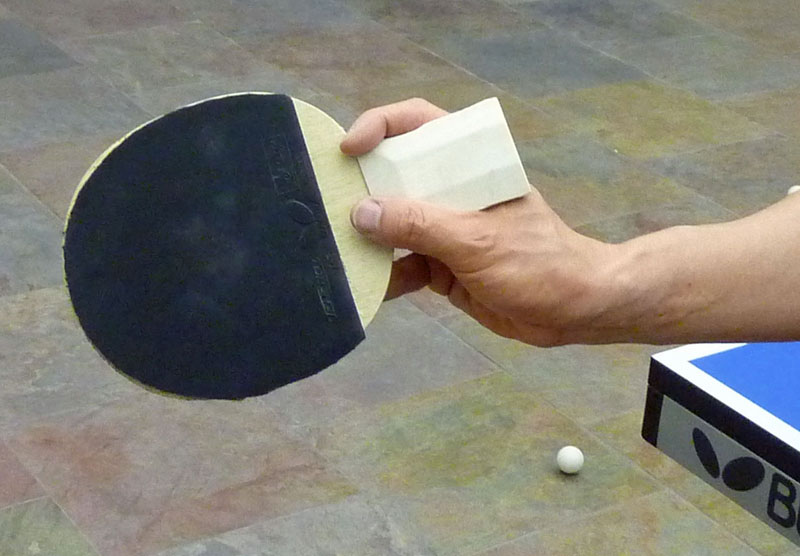 It's always interesting to try innovative ideas. Recently, I have been experimenting with a SuperCPen handle for the penhold grip. As the picture shows, the handle is extremely wide (60mm).
Unfortunately, for various reasons I've been unable to get to "grips" - so to speak - with the SuperCPen grip (at least so far).
(See blog entry here for the details.)
It's always interesting to try innovative ideas. Recently, I have been experimenting with a SuperCPen handle for the penhold grip. As the picture shows, the handle is extremely wide (60mm).
Unfortunately, for various reasons I've been unable to get to "grips" - so to speak - with the SuperCPen grip (at least so far).
(See blog entry here for the details.)
 With respect to the SuperCPen experiment, I had two paddles, a Butterfly Amultart and an Butterfly Innerforce ZLC, converted to the original 60mm wide grip. (I sent the Innerforce back a second time to be converted into SuperCPen S(small).)
I decide to reshape one of these, the Butterfly Amultart SuperCPen, back to a regular Chinese penhold handle but with a built-in or integral thumbgrip. As shown in the picture on the right, I accomplished this by removing part of the wide SuperCPen handle to accommodate the thumb. As the scale indicates, one welcome side effect is that the reshaped paddle is actually much lighter than the original handle because, despite appearances, the modified SuperCPen handle is actually lighter than the stock penhold handle.
With respect to the SuperCPen experiment, I had two paddles, a Butterfly Amultart and an Butterfly Innerforce ZLC, converted to the original 60mm wide grip. (I sent the Innerforce back a second time to be converted into SuperCPen S(small).)
I decide to reshape one of these, the Butterfly Amultart SuperCPen, back to a regular Chinese penhold handle but with a built-in or integral thumbgrip. As shown in the picture on the right, I accomplished this by removing part of the wide SuperCPen handle to accommodate the thumb. As the scale indicates, one welcome side effect is that the reshaped paddle is actually much lighter than the original handle because, despite appearances, the modified SuperCPen handle is actually lighter than the stock penhold handle.
 I had initially tinkered with the idea of adding a thumbgrip for Chinese penhold by simply using a piece of wood epoxied to the stock handle.
The idea behind the thumbgrip is that it provides additional grip surface area and stability for executing reverse backhand strokes. In my opinion, it is an improvement on the standard Chinese penhold handle for those who want to use a non-traditional backhand stroke.
(See blog post here for the details.)
I had initially tinkered with the idea of adding a thumbgrip for Chinese penhold by simply using a piece of wood epoxied to the stock handle.
The idea behind the thumbgrip is that it provides additional grip surface area and stability for executing reverse backhand strokes. In my opinion, it is an improvement on the standard Chinese penhold handle for those who want to use a non-traditional backhand stroke.
(See blog post here for the details.)
 Here is how I hold the modified SuperCPen blade:

 I use Tenergy 05 black on the forehand and Tenergy 05 FX red on the backhand.
How does it feel and play?
Well, it certainly feels pretty good in my opinion. The handle is extremely comfortable: the back of the SuperCPen is wide and flat and has a cork backing. My index finger can comfortably wrap around the front part of the handle. And the thumb has great support. The wrist can turn quite freely (nearly as freely as with a regular Chinese penhold handle). No morphological issues at all.
As to how it plays, well here is a video clip:
Link: here
I use Tenergy 05 black on the forehand and Tenergy 05 FX red on the backhand.
How does it feel and play?
Well, it certainly feels pretty good in my opinion. The handle is extremely comfortable: the back of the SuperCPen is wide and flat and has a cork backing. My index finger can comfortably wrap around the front part of the handle. And the thumb has great support. The wrist can turn quite freely (nearly as freely as with a regular Chinese penhold handle). No morphological issues at all.
As to how it plays, well here is a video clip:
Link: here