Showing posts with label treadmill. Show all posts

Wednesday, November 30, 2011

Apple iPod Nano 6g v1.2 (Part 2)

Back in early October, I gave a favorable report on using the internal accelerometer on the Apple iPod Nano 6g (when updated to v1.2), see here. I decided to test it again on the treadmill.

This morning, I was too fatigued to do the Al Corniche run I did two days ago (see here). (I was suffering perhaps too much from a skin allergy condition that has recently flared up again.)

As a result, I decided to simply run with the iPod Nano on the treadmill in cool air-conditioned comfort at the Mövenpick Towers hotel (see left) for about 30 minutes. The gym there does have a spectacular view of the Gulf from the 25th floor. Better than feeling sorry for myself and doing absolutely nothing I suppose.

But instead of setting a steady, fixed pace (like last time), I varied the treadmill speed up and down. In fact, I ran for the first 10 minutes at 12.5 km/hr (7.8 mph). Then bumped up the speed to 13.5 km/hr (8.4 mph) for 5 minutes, and dropped it to 10.0 km/hr (6.2 mph) for 5 minutes to recover. Finally, back to 12.5 km/hr for the reminder of the run.

So what would one expect the device to report? Well, one would expect something like the red line shown below (possibly shifted slightly vertically, modulo speed calibration of the treadmill).

I can report that the blue data points seem to track the red line fairly well. Though it's not clear there is much difference in the data recorded between the 12.5 km/hr and 13.5 km/hr sections...

(Note: I downloaded the raw data points and directly plotted it in Excel myself. For those interested, you can find them in the directory /Volumes/iPod Nano Name/iPod_Control/Device/Trainer/Workouts/Empeds/nikeinternal/synched when mounted on a Mac. )

This ridiculously heavy-handed smoothing is potentially a huge problem that renders the device useless under non steady state conditions.

(Ignore what I said above. In a previous edition of this post, I said the iPod Nano smoothed away the speed changes. Mea culpa. I screwed up. There was a mistake in my Excel formula.)

From my treadmill speed settings, I should get an average pace of 7'54" min/mile, assuming the treadmill was calibrated perfectly. The internal accelerometer gave me a 7'25" min/mile average or about 6.5% off the treadmill settings.

Monday, August 29, 2011

failure is the chance to do better next time

My fortune cookie this weekend said failure is the chance to do better next time.

As with life, so with sports. To reach out beyond what we are accustomed to, we have to (at least, gingerly) explore the discomfort zone.

Recently, I've been having problems getting my body to accept something beyond that 10K run at 7.0 mph, which I know I can repeat fairly comfortably (see Natural Training).

So I tried pushing things a bit last week.

However, running at 8.0 mph only got me 6 minutes before entering the red (anaerobic) zone (On the edge).

So I tried again on Saturday, this time at 7.5 mph.

As you can see, I basically tried to run in blocks of 10 minutes at 7.5 mph (1.33 miles) to keep the heart rate (HR) from entering the red zone. Then walk for 5 minutes inbetween to allow the HR to drop.

How do we evaluate this? Well, a measure of fitness that's commonly employed is to see how fast the HR drops during recovery (the faster it drops the fitter you are). What happened was this:
  1. At the end of the first block, my HR was 164 bpm. It dropped nearly 60 bpm to 106 bpm during the recovery. An encouraging sign.
  2. 2nd block, I started to run into trouble. My HR hit 170 bpm by the end of the 10 minutes. This is in the anaerobic zone for me. The HR dropped 55 bpm to 115 bpm during the 2nd recovery zone.
  3. 3rd block, I knew I was done. After 8 mins @ 7.5 mph, I was already back up at 170 bpm. So I shut it down.
My body's wimpy response to the 0.5 mph (1 km/hr) increase was kinda disappointing. Total fail.

I tried to do these 10 minute blocks as a natural interval workout, hoping to get my 10K in. Five 10 minute blocks would have gotten me nearly 11 km. Unfortunately, I stopped just shy of 3 blocks.

As any cyclist who has trained using a powermeter knows, time spent in the red zone is always costly. You have a fixed and limited number of minutes in that zone for your body. Every minute spent there will cost you aerobically in the end. And distance running is all about aerobic capacity.

So I knew every minute I spent at 170 bpm (rather than at 160 bpm) would hit me hard on the next block to come. And as I hit 170 bpm just 7-8 minutes into the 3rd 10 minute block, to paraphrase my friend Barry Dattel, there's no way, no how I could have completed the 5 blocks I had planned.

I have my excuses ready of course: it was a busy first week. I taught 4 times. Many meetings. And prepared and gave a colloquium talk as well. So by Friday I was all in the red, so to speak. Plus my body is not yet in marathon shape. Blah, blah, blah... but ultimately unconvincing.

After the frustration with the treadmill, I completely over-compensated and took it out on the spinning bike. This was workout #8 below:

I spun 615 kcal in 43 minutes (rate of about 860 kcal/hr). Average HR on the bike was 142 bpm, significantly higher than my normal relaxed time on the bike. In addition to the 467 kcal from the treadmill, the total kcal was nearly 1100 kcal. Yes, the workload was a bit high for a short workout. (1500 kcal would be a medium workout in my book.) But hey, it was a Saturday.

Taking a step back, the fortune cookie's optimistic interpretation of events, namely failure is the chance to do better next time provides perspective. We should see opportunity in every failure. There's a silver lining in every cloud and all that.

Case in point, this week an aftermarket part was not working properly anymore in my car.

Monday morning, I dropped my car off at the place that originally installed the offending part, but I had nobody to give me a ride to work.

I brought out my race bike, which has scarcely turned a wheel in anger since PacTour Elite Southern Transcontinental - and that was back in 2007, nearly 4 years ago (see Day 17).

And I rode the five miles or so to work in 100F heat. To my surprise, I felt fine. Arriving at the office, I smiled and thought: hmm, maybe I am not doing so bad after all. 106F for the afternoon trip back. But hey, round trip, it'll be ten miles. Good preparation for tonight's tilt at the treadmill.

Epilogue

As I promised, I tried again today after work.

Monday's results are obviously significantly better than Saturday's. Instead of three 10 minute blocks at 7.5 mph, I got nearly four 10 minute blocks in at 7.5 mph. (And getting in the target 5th can't be far away.) As a result I burned 615 kcal on the treadmill instead of 467 kcal on Saturday. Plus another 321 kcal on the spin bike afterwards gave me a satisfactory Monday total of 936 kcal. I call that a good start to the week.

Obviously, there are no scientifically valid improvements in aerobic capacity that are realizable in only 3 days.

The red line is the heart rate.
  1. As the graph shows, I reached 165 bpm at the end of the first block. It dropped to 110 bpm (55 bpm delta) on recovery.
  2. 2nd block, I reached 170 bpm, dropping to 119 bpm (51 bpm recovery delta).
  3. 3rd block, I reached 172 bpm, dropping to 125 bpm (47 bpm recovery delta).
  4. 4th block, I hit 172 bpm by minute 7, so I shut it down at minute 8. If I had persevered, the recovery would have been worse again.
These HR numbers are much as the same as on Saturday. There is no training effect possible so quickly.

So why was I able to last longer 2nd time around? Well, immediate gains are the result of neuromuscular adaption to running at 7.5 vs 7.0 mph. Basically, the muscles in the legs first get used to firing at an increased rate.
(Incidentally, same thing is true for weight room workouts. Initial gains cannot be from muscle size adaptation.)

The other effect is learning to survive at the higher heart rate (HR). Back when I used to train on the bicycle, I called it "learning to live in the 170s", i.e. getting used to the HR staying in the 170s bpm range for an extended amount of time. Of course, as aerobic improvement accrues, the sustained HR will drop for any fixed speed.

Tuesday, May 17, 2011

A half marathon

I've been having a serious bit of trouble sleeping recently. I go to sleep at a decent hour but I wake up too early. And have trouble getting back to sleep. Maybe there are other factors involved, but being fairly desperate about the sleep issue, I decided to exhaust myself completely.

Being fit enough to run a marathon at any time was one of my baseline goals I've mentioned in a recent entry (see here). The training program for that was basically to run a couple of 10Ks a week, and occasionally substitute in a half marathon.

So I put my money where my mouth is. I went and tapped out a half marathon on the treadmill in the gym.

An hour before the run, I went and bought a new pair of Newton running shoes to replace the tired and worn existing pair that I have. Even on the treadmill, there is a lot of pounding to 13.2 miles (21.1 km). So I figured I could do with fresh shoes. They didn't have my size in stock, so I bought a lower end shoe in the right size. It's the Sir Isaac neutral guidance trainer. There is a psychologically significant difference in weight (247g vs. 316g for each shoe) between this and their race shoe.

(See picture of me checking my download in the changing room after the run towards the end of this entry to see the shoe.)

I usually run using my iPod 6g Nano with music and the Nike+ attachment to record the mileage. (See details in a previous blog entry here.) It has a special half marathon mode. Bit like the marathon mode, it counts up the miles completed until halfway, and then counts down the miles remaining in the second half.

The special mode gives a small psychological boost and provides a little extra motivation to complete the workout. Stopping the workout would mean aborting the electronic countdown. And that's not cool. Hang in there baby!

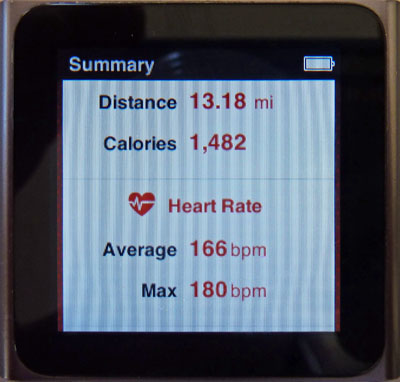
Here are the stats from the screen.

Yes, that an hour forty-five on the treadmill for nearly 1500 kcal burned. I also use the special Polar Wearlink HR strap to enable the 6g Nano to record my heart rate (HR).

For graphing, I used the basic technique described here (enable disk mode and drill down) to extract the raw data and plot it in Excel.

Step 1: Access raw XML data
<extendedDataList>
  <extendedData dataType="distance" intervalType="time" intervalUnit="s" intervalValue="10">
    ..comma-delimited list of distance values in km..
  </extendedData>
  <extendedData dataType="speed" intervalType="time" intervalUnit="s" intervalValue="10">
    ..comma-delimited list of speed values in km/hr..
  </extendedData>
  <extendedData dataType="heartRate" intervalType="time" intervalUnit="s" intervalValue="10">
    ..comma-delimited list of HR values in bpm..
  </extendedData>
</extendedDataList>

With the Polar Wearlink+ HR monitor active, HR is also recorded simultaneously with footpod data: in fact, the current values for three pieces of data - distance, speed and heart rate - are recorded by the 6g Nano every 10 seconds and stored in the xml file.

Step 2: Import data into Excel

Step 3: Scatter plot

Only real difference from the results shown in that earlier post is that I've used a scatter plot with HR and speed on different vertical axes (primary and secondary).

As you can see my HR steadily increased the whole way, despite sipping water every five minutes. I ended up downing two bottles of water (1 liter) and one gatorade (20 oz).

For those of you who are familiar with my blog, you can probably tell I err a bit towards the analytical side. I love instrumentation.

There is a discrepancy between the treadmill and the sensor I feel compelled to point out. In particular, speed-wise, I believe the Nike+ sensor gave me more credit than I deserved. I only set the treadmill speed to a rather wimpy 7.0 mph. But it gave me 12 km/hr credit. So either the treadmill is pessimistic or the Nike+ sensor is optimistic. As I said, I believe it's the latter case.

Well, I'm happy I managed to stay on the treadmill that long to complete the half marathon workout. But, as they say, the sixty-four thousand dollar question is: did I sleep well that night? Unfortunately, the answer was no.

Oh well, I guess I should trusted the treadmill not the sensor and run that extra kilometer more...

Thursday, December 9, 2010

Heart Rate Drift and Rate of Perceived Exertion

I'm what you might call a bit of a data junkie, but curiously enough I normally don't use a heart rate (HR) monitor. Let me explain.

On my road bike (or Computrainer stationary trainer), I have a powermeter that measures my output wattage (or workload). On the treadmill, I simply run at a fixed speed. For a given workout, I set the target wattage or treadmill speed manually and doggedly stick to it. Based on the rate of perceived exertion (RPE), I adjust the workout if necessary for next time. The HR falls wherever it may.

But that was before I acquired an iPod Nano 6G back in September (see blog post here). The 6th generation Nano not only records foot pod data but also can simultaneously record HR. Since then, I've been wearing my HR strap on treadmill workouts.

I ran twice earlier this week (Monday and Wednesday) on a treadmill in a very large, climate-controlled gym. There is a completely predictable and repeatable 20 beats-per-minute (bpm) rise in HR over the 50 min or so endurance run. See how remarkably similar the two profiles look below.

[Conditions: The treadmill speed was fixed to a lowly 7.0 mph (11.25 km/h) throughout each entire workout. (There is also a 5 min warm-up before the start that's not shown here.) The climate conditions in the gym were unchanging and perfect throughout. Also, I took a sip of water every 5 minutes like clockwork.]

So the HR drifts. Observable phenomenon confirmed. But what about perceived exertion?

Well, perceived exertion is actually also another pretty dodgy fish. Perhaps it's generally correlated with breathing rate in running but I'm not sure. But initially, I've noticed my RPE is relatively high during the first 10 minutes (despite the 5 min warm-up). I don't feel efficient. But I'm not breathing hard. After that, the RPE actually drops despite the HR steadily drifting upwards. I feel I am in the groove, so to speak. Nearer the end of the workout, I've noticed when my HR hits 168 bpm or so, I start to feel the RPE go up again. However, in neither workout did I exercise to exhaustion, or have to reduce the treadmill speed to accommodate fatigue.

So what can I conclude? If I go by RPE, I'd be adjusting the treadmill speed down, then back up and back down again. If I go by HR, I'd be steadily reducing treadmill speed as the workout proceeds. In the end, I think all of this is really just data for data's sake. There's a lot to say for just ignoring these indicators, beloved of coaches and exercise physiologists, i.e. leave those two up and down buttons alone, and just doing the damn workout and burn your way through those 700 kcal.