Showing posts with label table tennis. Show all posts

Wednesday, February 15, 2012

Y&T S-27 table tennis robot

You go back, Jack,
do it again...
wheels turning
'round and 'round
You go back, Jack,
do it again...

I have a Y&T S-27 programmable table tennis robot.

It is a high-end robot made in China. In 2010/2011, it was considered state of the art. I bought it in Zhongshan (中山), China back in 2010 and had it shipped home.

I only take it out about once a year because I prefer to play with people. Human beings have more natural variation, which can be both a blessing (helps train adaption) and a curse (inconsistency). The other big problem with the robot is that it doesn't have arms: you cannot see it swing at the ball like a human being. A large part of anticipation is seeing how the opponent reacts to and contacts the ball. With the robot, the balls just shoot out almost without warning from a tube.

Last night, for the first time in over a year I used the robot to do a drill. (Usually, I'm fortunate enough to be able to find players to come out and hit with me.)

I programmed a drill asking the robot to send alternately one topspin ball slightly to the right of the centerline (position 7) and one to the forehand corner (position 10). One from each physical robot head. I asked it to send 40 balls and stop. (As the video belows shows it actually sent 41 balls.)

The way these robots work is having a spinning motorized roller shoot balls from a tube. The more sophisticated robots use two rollers. The spin and speed of the ball is determined by two (orange colored) spinning motorized rollers: one that brushes the top of the ball and one that brushes the bottom. You get topspin if the upper roller spins faster than the lower one, and underspin if the lower one is faster.

I set the top motor to speed 6, and the bottom to 1. This means the balls comes to me already loaded with topspin. The higher the speeds, the faster the balls.

The frequency of ball delivery was set at the 2nd slowest setting. This produced balls at the rate of 1 per 1.75 seconds. That gives me plenty of time to recover between balls, and perhaps approach the ball a bit more deliberately instead of frantically trying to keep up and reacting like a headless chicken. And as I get used to the drill and learn to anticipate the ball, cognitively I'll be less overwhelmed, and be able to work on improving my form. At least, that's the theory...

The control panel settings are shown in the picture below (left side for left head, right side for right head):

I'm currently trying to retool my forehand loop stroke. In the following video, I'm practicing my counterloop; that is, I return the incoming topspin ball with topspin. Fight fire with fire, so to speak. I'm only partially there. I'm trying to backswing less these days. This saves precious tenths of a second. And I'm think I'm finally succeeding in this aspect.

(There are other strokes possible. For example one could simply block the incoming topspin. Especially if one has less time. See my earlier post and video with Crystal Huang here.)

Also, having the robot send balls alternately to different positions helps me train my feet to respond properly. I have to move. And keep my balance. Loop. And then not have my loop stroke throw off my balance because I need to respond to the next ball. Multiple small hops are vastly preferable to a single larger step because this allows for fine-grained adjustment. You'll be surprised how many hops are possible in half a second.

Maintaining balance conflicts with how strong you can counterloop. The momentary stop for balance on the right leg, and the waist twist and weight transfer are crucial aspects of this part of the counterloop equation. Although my loop percentage rate is satisfactory, judging by the video clip, I could improve quite a bit on the quality of my loop.

Link: here

Moreover, my followthrough is not where I want it to be at the moment. This affects the amount of power delivered tremendously. It's way too much to the right, crossing the imaginary centerline of my body. Where the stroke finishes also affects recovery time. This is a stroke error. Instead I'd like it to finish with the paddle more out to the front. Technically, I also need to work on holding onto the extended stroke position momentarily at the end of the stroke. I automatically drop the paddle at the end of stroke which prevents proper transitioning. This is another error.

These are all good reasons why you want to resist the temptation of setting the machine to shoot as many balls per second as you can cope with. It makes good sense to debug the stroke fully before increasing the tempo.

In summary, the robot is not just useful when you can't find anyone to play with, it's also a good tool for reprogramming muscle memory. The problem of course is making sure the new program being written is a true fundamental improvement over the old. That's where video analysis is extremely useful.

Saturday, February 4, 2012

A lesson with Crystal Huang: two left feet

This is the third entry in my continuing series about learning table tennis technique with Crystal Huang, a professional table tennis coach. These video clips were taken at the LATTA last weekend. (Previous entries can be accessed here: #2 too many degrees of freedom and #1 structural reform.)

Have you ever had the experience of attending an aerobics class at the local gym but came away discouraged, feeling utterly unable to follow the moves? If you understand what I'm referring to, you might empathize with me. If not, I envy your natural talent.

The video here will demonstrate that I am a particularly embarrassing example of two left feet. Since footwork is paramount in table tennis, this is a very big developmental challenge: a potential showstopper. In fact, it will become apparent that I can't even figure out a simple two point five step move even when it is repeatedly demonstrated right in front of me. Thank goodness for computer software, only when I viewed it frame by frame did the proverbial lightbulb go off in my head.

The specific challenge here is to move in correctly when the ball is played short to the forehand. Generally speaking, we have about 1/3 of a second to respond appropriately. Proper footwork is essential to getting in close enough to execute a decent flip, smash or push stroke over the table. Possessing a good stroke is useless without the necessary accompanying footwork. Rather like being all ready to ski without an appropriate vehicle to get you up the slippery snow-covered roads to that mountain that looks so good in the distance. Not sure that's the best analogy but, in table tennis, speedy footwork is needed to deliver us in about 2/10ths of a second close to where the ball bounces while retaining good body balance. And proper balance is needed to support good stroke execution and facilitate recovery.

Because this is all about movement, let's go to the video directly. We begin with the following drill:

Here the instructor stands at the top right corner of the diagram. The ball is blocked randomly to my backhand and forehand. I'm having trouble getting close to the forehand ball, especially when it bounces short near the net.

I have taken the liberty of adding commentary and translation where appropriate so you can follow Crystal Huang's instructional style. (For those who prefer to skip forwards, minutes 8:19-9:26 is where I'm utilizing the footwork in point play.) Also, since the video is a bit long, you might want to click on the "I" icon and set the resolution to 360p for a faster download.

Link: here

As should be clear from the video, my clumsiness resulted from my lack of understanding of how to perform the step, stop, step sequence. That is because I didn't understand what was really happening in real time. For those as translationally challenged as me, let me offer the following frame-by-frame explication. Thank goodness for video editing software.


(A)

(B)

(C)

(D)


(E)

(F)

(G)

(A) is the starting position.

In (B), body weight is shifted to the right.

This unweighs the left foot, which allows it to move towards the right foot, as shown in (C).

You can then stand on the left foot in its new position, and unweigh the right foot. This is shown in (D).

Then it's just a matter of picking up the right foot and placing it in under the table. This is exhibited by the sequence (E) through (G).

Notice the racquet arm does not move until (F) and (G). In other words, you don't backswing first and move later.

At (G), the weight is transferred to the right foot. Next, we need to lean the upper body over for reach when the ball lands short or close to the net. The left foot may go back a bit to counterbalance the torso lean. The free arm is often also used for this purpose.

Finally, one more critical point that may not be immediately apparent to some ping pong students is the fundamental idea to always pause momentarily and re-balance first after moving before hitting the ball. In this case, this would be just after the lean over from (G). That slight pause for balance makes all the difference in the world in making the push or flip stroke crispy (my terminology), i.e. much more effective.

If you need it, here is the video version of the frame sequence:

Link: here

Wednesday, February 1, 2012

A lesson with Crystal Huang: too many degrees of freedom

This is my second blog entry in this series about learning table tennis technique with Crystal Huang. For the first entry and a description of the motivation and goals of the series, see here.

The human arm is said to have 7 degrees of freedom. At the shoulder, we have 3 of those 7 degrees: up/down (i.e. pitch), left/right (i.e. yaw) and the ability to rotate (aka roll). The wrist is independently capable of pitch, yaw and roll as well. That makes 6. Finally the elbow has a single degree of freedom (pitch). So if you like, there are 7 positional parameters to the system.

When you perform an arm stroke, the number of parameters in the system multiplies. For example, we now have acceleration of the various parts of arm to take into account. Then factor in timing, and the position of the torso, center of gravity and feet placement. Add to that subtleties of ball contact and feel, and adjustment for the speed and spin of the incoming ball and where you intend to place the return, and you can see how sometimes it's difficult it is to reproduce a stroke even when we have it demonstrated for us up close and live. Anyway, that's my excuse for being a poor learner.

In the following video, I'm trying to learn a new forehand push stroke. The idea is to be able to receive the underspin (or sidespin) ball with the forehand side of the racquet, control and send it to different positions on the table reliably. I already have a forehand push I've been using for years, it's just not a good one.

The day before the video was recorded last weekend, I had about 15 minutes of instruction on the new stroke. Unfortunately, I confess I didn't truly "grok" or properly understand how the stroke should be executed. Even having the correct stroke demonstrated to me didn't trigger how it should feel. I was still not executing it well.

As this video clip shows, Crystal (after shaking her head) ended up coming around to my side of the table and moving my arm for me. This reduces the number of degrees of freedom of the arm to zero. And only then did I really understand what the stroke should feel like.

The video also contains captioning that I've added of Crystal's instructions during the session. This might be of interest to other table tennis students.

The video clip ends with me using the new forehand push to return service to different parts of the table. And then playing out the point.

Link: here

Sunday, December 11, 2011

Doha: CMU Qatar

After the social robotics conference in Amsterdam (see here), I spent a week at Carnegie Mellon University (CMU) Qatar.

I last blogged about CMU Qatar back in 2009 when I took a bunch of spherical panorama pictures (see here). This time I also brought my equipment but unfortunately had no time to take more of those special images. In particular, I had hoped to get a 360° shot of the following open seating area inside the building:

Unfortunately, this time half the space was set up with regular chairs instead of those awesome cushions. Maybe next time.

The building itself is quite opulent and certainly impressive, more reminiscent of an investment bank than a university. It has huge atrium-like open spaces that I find too big to be friendly. Designed to awe, I find it lacks human scale.

(I think of grand entrances on Arrakis designed to reduce the human to a mere mote, as described by Frank Herbert in perhaps the book God Emperor of Dune. It has been really many years since that read that series. Who has time these days to read a few thousand pages?)

My favorite room was the faculty lounge, not only because of the espresso machines but also because it has a nice friendly yet contemporary feel with proper wood floors instead of the echo of polished hard marble, artfully concealed indirect lighting and absolutely wonderful proportions. I'd love to have a house with a central living area like this. Dream on.

(Actually, if you look at houses like this one in California, you could make it work.)

Despite the luxury of having uniformed waiter service at my office, I often preferred to make the trek down to the faculty lounge myself.

The infrastructure is important, but in the end it's the personal touch that matters. My hosts made me feel supremely welcome.

For example, one of my sponsors drove me from the hotel to the university each morning until he got sick. After that, I rode in on the QIA Hummer H2:

I even met a ping pong enthusiast from Brazil, Prof. Marcelo Castier, a chemical engineer from Texas A&M University. An extremely busy man, but he managed to find one hour to hit a few balls with me at the brand-new student center the day before I left Doha.

They have three KillerSpin tables there:

Unfortunately, the polished floor is extremely slippery, the pool tables get in the way, and one is blinded by glare from the wall of windows from one end. But hey, these seem to be the only available ping pong tables.

Tuesday, August 16, 2011

bad sneakers, do it again

Imagine, if you will, my car smoothly eating up the miles in the desert on I-10. I'm on my way home from Los Angeles.

A mere press of the window lift away, it's over 110F (43C) but inside, it's deliciously cool and quiet. As the sun reddens behind me, I settle into the cooled seat which will be my home for the next six and a half hours. Relax, connect up the iPhone, in seconds I'm down in the world of Steely Dan's sophisticated mix of jazz and melancholy.

As the doubtlessly well-informed reader that you are, you already know I'm listening to them from the title of this blog entry. I reflect on what has been a good visit.

Five names that I can hardly stand to hear
Including yours and mine, and one more chimp who isn't here
...

That's how the song Bad Sneakers begins. For a moment, I think back to New Jersey days. Those Butterfly 808 table tennis shoes pictured above look brand new but are over 12 years old. Having languished in a dark box for all that time, they are essentially new, unused after I ordered them back in the late 1990s.

I figured it's about time these "sneakers" emerged into the light again. Since I've restarted table tennis, I've stuck to my marathon running shoes for cushioning and comfort. I've been re-purposing my Newton Sir Isaac neutral guidance trainer (see picture at the bottom of my prior entry A Half Marathon). You may be surprised to know these Butterflys (538g) are heavier (and offer less protection) than my Newton neutral racers (500g).

(Out of all the sports I dabble in, my bicycle racing shoes are by far the lightest, at around 320g. Yup, one Butterfly shoe is nearly two bicycle shoes.)

But, as the saying goes, it's very much horses for courses. Those Butterfly shoes have a very low heel (to protect the ankle) and (by design) a natural rubber sole that balances the ability to slide and make small adjustments with grip. With respect to cushioning (to protect against fatigue), let's just say they work best with a professional (cushioned) floor that the best clubs have.

As long as we're talking numbers here, have you ever wondered why cars report the outside temperature but never the inside?

As you can see, the automatic climate control is set for 74F (23C) but the actual temperature at head level is 32.3C (90F) with 12% humidity (it's the desert).
(Notice the fan is barely running. In other words, the car thinks it has reached the correct temperature.)

Back to the coolness of Steely Dan (and Do it again):

You go back, Jack
Do it again
Wheels turning round and round
You go back, Jack
Do it again
...

There are no quick fixes in table tennis (or life for that matter). Old habits are ingrained into muscle memory and die hard. Once we recognize our technical problems, it takes considerable work (i.e. time), dedication (i.e. make time) and a certain kind of optimistic stubbornness (it will come, it will work out, give it time). Those who promise quick and easy fixes are mere charlatans.

When you know she's no high climber
Then you find your only friend
...

I'm not completely sure what some of the songs mean, but people have said this breakout tune of theirs is about addiction, second chances and the inevitability of fate. I muse, hmm, this is my 2nd time around at table tennis. You could say it's an addiction. But I'm not sure what fate has to do with it...

Perhaps then my occasional weekend trips to Los Angeles are about a leap of faith.
  1. Dedication: I have to drive 13 hours round trip.
    I prefer it to flying because of convenience. Flying basically involves nearly 5 hours each way counting time spent getting to the airport, parking, going through security, waiting around, renting a car etc., only actually saving 3 or 4 hours round trip. So far, unless I have been driving all night, I have been able to arrive alert and relaxed enough to take a lesson after a short break.

  2. Work: to maintain quality, a lesson lasts only 90 minutes.
    Why? Well, multiball is physically demanding. I go through three shirts (sweat saturated), two bottles of water, a Gatorade and a towel in just 90 minutes. Willing the body to continuously move, move, move to get to a position and hold balance, stop momentarily and get the shot off. It's not about mindless or brute force strength. The coaching is intense: every improperly played ball (never mind the missed ones) gets reviewed and highlighted. Nothing is missed. Correct form is everything. Struggling with yourself on a conscious level is also mentally taxing (not to mention, frustrating, at times).

  3. Optimistic stubbornness: that's a few sessions per weekend maybe once every other month or three. (That's pretty far from the ideal of training 3 or 4 mornings a week.) It's a legitimate question to ask whether anything can be learnt and retained in such short bursts. Without constant feedback and application, one tends to revert back to old habits.

At this point, I can report that I am finally starting to see glimpses of the promised land. As I mentioned earlier, give it time, it will come. My body is beginning to react and move differently. Because how you move and maintain balance is everything, it affects all aspects of the game. Tension has been transferred from the shoulders into the forearm. Suddenly I go from looping two or three balls to twenty or thirty in a row. They're not all perfectly minted, mind you. But now and then I feel my center of gravity doing the right thing. And it's definitely not the shoes :)

Fundamental change is possible, and on my long drive through the desert, that thought makes me happy.

For match practice, I also play in LATTA's Saturday afternoon's advanced league. Typically, I take a lesson in the morning at 10:30am. Then break for lunch at noon.

(There is a cheap chinese eatery nearly directly across the road. They also serve protein shakes not on the menu.)

Back to the club at 2pm, it's a round robin group format. You play 5 or 6 matches. Because it's such a large club with several leagues, the level on Saturday afternoon is good, all are hardened and experienced players. Competition is ferocious. No match is easy. As I can easily see myself losing every match, I'm amazed sometimes I even manage to win any. After the round robin phase comes the single elimination phase. It all finishes around 7pm.

For example, last Saturday I played a total of 32 games (including 10 straight with a guy who wanted to learn my style and me, his). By this point, I've put in close to 7 hours. I'm tired and ready to book myself a long massage. Despite some lingering fatigue, the underlying fitness is there. I know I can recover in time for tomorrow morning's 90 minute three shirter.

On Sunday morning, I'm a bit stiff but after warming up, it's time to see if recalcitrant muscle memory can be bent a bit more until it yields. After the lesson, it's noon time and I've made special arrangements to play my 1600 nemesis, Zhu Min Ming (see earlier LATTA entry). I've never even managed to take a single game off her but she is kind enough to offer her number and say practice with me. Her consistency and control game is way ahead of mine and her long pips backhand isn't easy to handle. However, this time there is a titanic struggle with long rallies. No matter how many loops I bang in, she always has an answer. But somehow this time is different. I finally manage to prevail and come out 3-1 ahead.

I'm carrying my fortune cookie from last Sunday.

It's an epochal moment. I know I have passed some test.

(I have a sneaking suspicion she makes sure she is perennially underrated. She is almost at 1900 now and needs to start discounting again.)

At lunch, she calls me and says someone is waiting to play you.

It's like something out of an Indiana Jones movie or kungfu novel. It seems Zhu Min Ming has passed me onto challenge number 2. His name is Duc Loi, and he is over 60. Plays every day. Can chop away from the table. Can stay at the table and work you over with placement. His speciality is attacking with the long pips. He is rated over 2200. I am warned even 2400 players lose to him first time around. Of course, I lose 0-3. Like Zhu Min Ming before, he offers me his card and says call me to play when you are in town. I know he is a benchmark. 過三關 and all that. It's definitely like something out of a movie.

Appendix

One of the advantages of Los Angeles is that it is a big city with large ethnic populations. Population density makes for convenience. You can find everything within a 3 mile radius. The Monterey Park/San Gabriel "ghetto" is one such enclave. And local competition ensure low prices and high quality. It almost fully mitigates against the traffic, lack of green, open space and poor air quality that characterizes the area.

There are 3 table tennis clubs run by high level professionals within a mile or so of each other. I've never been to the others. The LATTA is the largest.

I have also established a routine here. I know where to go for what. I typically book the same hotel or another one. I trade off convenience against an oasis of green and quiet perched up on a hill. Either way, it's just five or ten minutes more.

Saturday morning, I go for dim sum before my 10:30am lesson.

Always at the same place (海寶潮粵海鮮酒家), they're open early. No queuing up. And more importantly, they always have my lotus seed paste buns (蓮蓉包) correctly configured with egg yolk. (I'm very particular about that.) And it's pretty good but not expensive. (Okay, whaddya expect, it's no match for 稻香.) Still, no reason to go anywhere else.

I always go to the same massage place (快樂按摩) straight from the club. I choose them because they have a shower so I can clean up first. $25/hr plus tip is the going rate around here.

I know where to go for cheap food. I have a favorite noodle place, a decent thai place. Even the $12.95 sushi place is unpretentious and the taste is fine. Back in town, they'd make a big deal about it. Here, it's just another place. (Okay, it's not Sushi Say (寿司清) Tsukiji main branch (築地本店) in Tokyo, but this is frickin' Southern California, whaddya expect?)

And for the observant, yes, that sign shows $9.99 for one hour foot massage. Amazing isn't it?

Sunday, August 22, 2010

A Ping Pong Palace

Many contemporary houses or lofts offer high ceilings and the promise of open space. And the opportunity to explore the flex room concept.

I recently decided to give some thought to organizing my living room so that it could be transformed into a space for playing table tennis (and back again) in a matter of minutes.

The requirements for table tennis are quite simple. Enough space to put a table (9' x 5') and have room to move about (in my opinion, bare minimum playable dimensions should be at least 3 table lengths and 3 table widths: although the width is fine, most two car garages (20' x 20') are therefore not long enough).


[Variety of minimum dimensions for the playing area, from recreational through to international level events.]

The space has to be extremely well lit (beyond typical residential levels): lighting should be well controlled, i.e. even (no shadows, overly bright or dark spots) and glare-free. Floor should be even and durable enough to withstand gym shoe pounding and be easy to clean. And neither be too slippery (as with dusty concrete or ceramic tile) nor have too much friction (as with carpeting or rubber mats). For multiple ball training use, barriers or screens are needed to stop balls from marking walls or disappearing into hard-to-reach areas. Depending on geographical zones, the playing area might need to be completely climate controlled.

Sure you could play in a basement or garage but low ceilings can restrict lighting choices and any support columns can interfere with play. Moreover, those areas are not usually climate controlled and dust can be a major problem. A dedicated, purpose-built gym room would be the gold standard, but let's suppose you want to explore the flex room concept without making your living room look like a garage. Here is what I came up with:

Details are as follows:
  • Lighting: Two rows of indirect/direct light fixtures suspended 2' off the ceiling (source: Architectural Indirect Version 4, H.E. Williams Inc). Spaced so you don't see the lights directly when at the table looking up. Each row contains 6 end-to-end interlocking 4ft units. 3 T8 high performance fluorescent 32W tubes are mounted per fixture. Designed for about 700 lumens at the table. Wattage: 1152W total.
  • Table: A folding rollaway Butterfly Centrefold 25 table (US Open 2010 model). Color blue. Japan-sourced Butterfly International net set. Color blue.
  • Floor: Sealed slate tile floor. (No Gerflor here.)
  • Ball barriers:There is a (removable) retractable clotheslines reel (source: Home Depot) hanging across the home entertainment center end of the room. (You can see it just above the sake bottle-styled lamp.) It supports a super-lightweight black (nylon) plastic mesh net (6' high x 20' wide, made of 0.5cm squares, weighing less than 1 lb, source: Tokyu Hands). At the other end of the room is a floor to ceiling screen (12' high x 20' wide) operated via a hand crank, see below.
  • Robot: Y&T S-27 from China. Not shown.
A first evening for the facility, inviting friends around to play, eat watermelon and drink chinese tea:

Here is a time-lapse video of the room transformation from living area into ping pong palace.

(All pictures except the first taken using the Panasonic Lumix 8mm f/3.5 micro-4/3rds fisheye lens on my Olympus E-P1.)

Thursday, April 8, 2010

Shenzhen Ping Pong: adding serve to the drills

This is a follow-up to the previous blog entry (here) about the two to the backhand, one to the forehand drill - aka the Falkenburg drill.

Most drills are just that: simply drills. In other words, doing a drill isn't like playing a point.

Performing a drill competently doesn't necessarily translate well into game play. Sometimes this can be rather frustrating: especially when what we practice doesn't work when we encounter the same situation during point play. For amateurs like myself, this can seem very discouraging and make the drills seem rather pointless.

To counteract this situation, one can simply integrate elements of point play into a drill. Here what follows is a two stage approach.

It looks rather complicated but stage 2 is just the same footwork drill as before: 2 to the backhand (to be taken with the backhand followed by the forehand, respectively), followed by 1 to the forehand.

Stage 1 will segue into Stage 2 but begins by
(1) you serving underspin.
(2) Your partner pushes the ball back to your backhand.
(3) you forehand loop it into his backhand.
(4) He blocks down the line into your forehand.
(5) You forehand loop down the line.
And (6) he blocks back to your backhand. And then Stage 2 ensues.

In stage 2:
(7) you backhand drive cross-court to his backhand.
(8) He blocks it straight back to you.
(9) You forehand loop from the backhand side.
(10) He blocks down the line.
(11) You forehand loop down the line. And repeat from step (7).

(Note it's not so complicated for the partner. All he has to do is simply repeatedly block two to the backhand, one to the forehand except for that initial push return of serve to the backhand.)

I think it's considerably easier to watch than to describe. Let's go to the video:

(Direct link here.)

This complication (stage 1) gives the footwork drill the flavor of playing points.

Wednesday, March 31, 2010

Shenzhen Ping Pong: adding footwork to the drills

In table tennis, mobility is critical in games. Being able to move means one can take the initiative to attack and put your opponent under pressure. Being able to move also increases your options in terms of shot selection. Finally, being able to move means being able to hit the ball correctly and consistently when the incoming ball is not perfectly placed.

Therefore acquiring decent footwork is of extreme importance.

Ingraining a new stroke into muscle memory begins with drills (isolating that specific stroke) from a stable but static position, e.g. the backhand can be initially developed by hitting only backhands from a known, fixed position.

One can progress from there to integrate the new stroke with others. For example, my previous blog entry (see here) explores a drill for alternating the reverse penhold backhand stroke with the forehand.

A third step (and the topic of this blog entry) would be to throw in footwork into the mix as well. This puts additional pressure on proper stroke execution. Not only do you need to be able to execute the same stroke as in the static drills, but proper setup and recovery (in terms of feet and body position) are additional burdens that you need to tackle and successfully execute. And since errors will compound, these drills are especially demanding.

Let's begin with a two-one backhand/forehand drill. As the diagram indicates, this is a sequence of three strokes, two to the backhand side and one to the forehand. On the backhand side, first ball should to be taken with the reverse penhold backhand, the second with the forehand after stepping aside. Then move to the forehand side to take the third ball. Finally, you must make the return quickly to take the first ball of the next sequence with your backhand. (This version of the drill is also known as the Falkenburg Drill: thanks Kitt!)

Obviously, the additional degree of difficulty over the previous drill comes from the footwork required. (If you revisit the previous blog entry and look at my feet, you'll notice it's possible - but not necessarily optimal - to do the one ball to each side drill with very minimal footwork.)

Let's go to the video: (Direct link here.)

Hmm, my form is not great. I will expand this blog post when I have better videos and show variations on the drill...

Double Happiness practice balls:

(You need to find a practice partner who can direct his block reasonably accurately to both sides, at least initially until you get really good at the drill. I thank my friend Hideya Watanabe here for doing an admirable job.)

Saturday, February 6, 2010

Shenzhen Ping Pong: drills for integrating the reverse penhold stroke

As an amateur I find it's sometimes frustratingly hard to make fundamental changes to my table tennis game. Sometimes it seems completely futile. No matter how many times I'm told I'm not doing it right, despite my best efforts, I'm repeating the same errors over and over again, especially when under pressure.

Table tennis is a fast game. Good reflexes and muscle memory are activated when we play shots. Since muscle memory is largely automatic, and many of us amateurs did not learn the strokes correctly to begin with, e.g. not everyone hits like Lu Yan (see here), changes to the way we hit the ball will involve substantial re-programming.

Therefore, when it comes to a new stroke, formal drills are a good first step towards proper integration.

In my case, learning the reverse penhold stroke (see summary of posts here) has changed not just my backhand, but has also revealed fundamental weaknesses in other strokes.

In other words, one has to take a totally holistic approach to the game. And thus a single change may involve a cascade of additional changes in order to take advantage of the new stroke.

One year ago, I went to Shenzhen to learn the new reverse penhold backhand only. Although I knew my (far from perfect) forehand loop had its quirks and limitations, I did not think it was the limiter in my game. I did not anticipate having to completely re-work it to accommodate the use of the backhand.

My approach has been to visit the Shenzhen Century South China Table Tennis Club (深圳市世纪南华乒乓球俱乐部), record my practice sessions, study (i.e. attempt to understand) and try to incorporate suggested modifications and improvements back home.

One doesn't necessarily need a professional coach to do the drills. Not every ball has to come back. A box of balls and a patient practice partner will do. Assuming one knows what to look for, I found video review to be invaluable in helping to close the gap between what I believe I was doing and what actually happened out there.

Here is a pair of drills I used. The venue is Warabi (蕨) municipal sports center, just outside Tokyo. I try to implement the lessons from Shenzhen through twice weekly practices with my friend Hideya Watanabe.

Let's go to the videos. First up, forehand/backhand to the practice partner's forehand. (He blocks alternately, one to each side.)

(Link (Link here.)

Second, forehand/backhand to the practice partner's backhand.

(Link here.)

Remember earlier I said I had to change my forehand stroke completely? Compare the above video with the following drill recorded 4 month earlier (from prior blog post here).

(Link here.)

Can you spot the key differences?

Update:

Video was recorded using a Panasonic DMC-TZ7 in HD mode (1280 x 720p) in the corner of the court at the widest possible angle available for the camera, a focal length of 24mm-equivalent for 35mm format. The difference between the two setups shown is one of height.

By using a center column extension such as those made by Habuka, one can increase the height of the camera from 1.5m to over 2m for a better position without buying an expensive, tall tripod with a huge footprint. (You can compare the relative heights relative to the notices on the back wall.)

Since the Panasonic compact only weighs in at about 220g, this does not make the tripod unstable.

The 1 minute forehand/backhand to the backhand drill below is an updated video clip taken at the higher camera position.
(Link here.)

Can you spot how my stroke has evolved from the earlier videos?

Sunday, December 6, 2009

No ping pong in Doha?

I've been here a month in Doha working at CMU Qatar.

Like many unfamiliar cities with a large expat population, once you learn a few things and get to know Doha a little better, it's possible to find decent food and just about anything... except ping pong perhaps.

I've tried emailing the Qatar Table Tennis Association. I've put out feelers on the Table Tennis group on qatarliving.com. Never got a reply. There is an ITTF event in Doha every year. The Qatar Open attracts the best players in the world. Sport shops sells cheap paddles. Players? I haven't found any.

As a last resort, I went to the Table Tennis social hour scheduled for Monday nights at the Recreation Center in Education City. Predictably, the room was completely empty. Nobody showed up. They have truly excellent lighting and three tables. I'm sad.

So what did I do? No robot. And I only had two balls. I stared into the mirror and practiced my serve for an hour... Why did I make this blog entry? Well, a search engine will pick this up if someone is looking for table tennis in Doha. The Activity Room upstairs at the Recreation Center, Education City. Now you know.

Update: Something to think about...

My game declines when I'm not playing. The longer I'm without practice, the rustier I get. But to my surprise what I'd call the strongest parts of my game are not necessarily the parts that are best preserved or decline the least.

For example, most people who know me would say my forehand loop is the strongest part of my game. But after nearly two months without playing, I realize my forehand loop is off. Surprisingly, my reverse penhold backhand (a relatively new stroke for me) is still there.

I think there are two possible explanations:
  • My forehand loop is much stronger than my reverse penhold backhand. So there is less to deteriorate to begin with with the backhand stroke.
  • My forehand loop was developed through sheer practice and not from strong fundamentals. It relies on excellent timing. Without constant practice, it simply doesn't work. That is, the percentage landed is low.
    On the other hand, my reverse penhold backhand has been coached professionally from the beginning. So although it hasn't had the time to become as well-developed as the forehand, the fundamentals are better and don't require as much calibration.

Food for thought...

Tuesday, May 5, 2009

Ping Pong: Yokohama World Championships

I've been following the 2009 World Table Tennis Championships over the internet, on Japanese TV and live in person at the Yokohama Arena. Whew!

The finals just concluded yesterday.

Let's begin the day appropriately with a little dimsum in Yokohama's own Chinatown (横浜中華街):

Then head on up to Yokohama Arena in Shin-Yokohama (新横浜) to watch the matches.

Me, clutching my precious ticket for the men's and women's singles finals.

6,000 yen. Arena premium seating. Row 7. Worth every penny...

I sat in the section opposite the umpire. Apart from the tv cameras moving around, I got a great view.

Below is Wang Liqin (王励勤), world #5, in game 3 about to deliver a blistering forehand loop to Wang Hao (王皓), world #1:

It's a shame Wang Liqin lost 4-straight. But to be honest, I was really rooting for the other Wang anyway. Wang Hao uses the less common penhold grip. He has a great reverse side backhand loop game as well as a very strong forehand (the traditional hallmark of a penholder).

Here is a HD video clip of a point I recorded using my Panasonic Lumix DMC-TZ5 from my seat. It nicely illustrates Wang Hao's two-winged attack style:

(Also available on Vimeo here.)

Simply put, his two-winged attacking style is the definitive version of the modern penhold game.

(As a penholder, I'm trying to learn the reverse side backhand loop to update my game. See my Shenzhen Ping Pong series on the topic: in particular, the entry here, and the series link here.)

The women's final featured the rather intimidating world #1 Zhang Yining (张怡宁) against the young defending world champion Guo Yue (郭跃), ranked #2.

I also love to watch the attacking style of the lefty Guo Yue. I like this motion blur shot of her looping because, for me, it captures her incredible speed.

All eyes on Guo Yue, as she is about to serve:

She won the first two games, but proceeded to lose the next four. Here is a HD-available video clip I took of a point illustrating her attacking style (score: 5-3 in Guo's favor but Zhang Yining is up 3-2 in games):

(Also available on Vimeo here.)

I used a little bit of zoom on my DMC-TZ5 to capture that rally.

The final HD clip below (at 10-6 and 2-2 in games) when viewed in full-screen mode is more representative of the kind of view I got from row 7 of the premium seating area.

(Also available on Vimeo here.)


(I honestly don't know how people up in the stands can see anything. After all, the ball is only 40mm in size.)

Videos of all the matches are available on the International Table Tennis Federation website (ittf.com). My favorite point in the men's final is at 30:19 in. Score: 2-0 in games and 4-2 in points. Check it out!

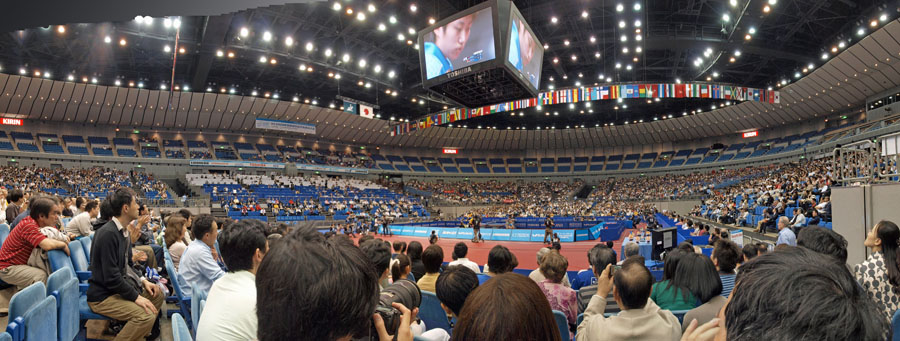
A last (panoramic) look at the venue for the 2009 Worlds: the Yokohama Arena:

Awards ceremony: China swept the men's singles (and women's too):

(L to R: Wang, Wang, Ma, Ma)

The championships are over for another two years. Let's head on back down to Chinatown to put on some more weight...