Wednesday, October 29, 2008

New running shoes

Recently, my shins have started to ache on my runs. Shin splints are an overuse injury.

According to experts, this is a sure signal to buy new shoes as the cushioning is no longer effective.

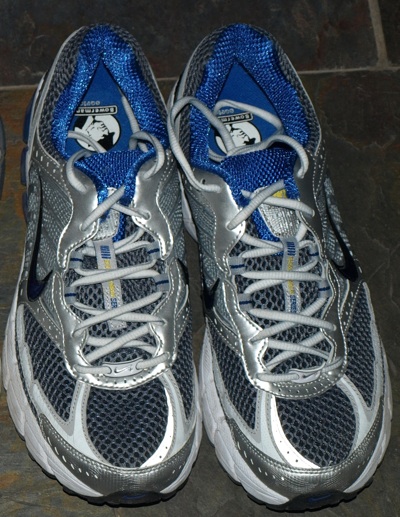
I've accumulated only 200 miles or so rather than the expected 350-500 miles on my Nike Air Zoom Vomero 2+ but they're certainly over 6 months old.

To prolong the life of the old shoes would be false economy, as ignored shin pain can result in stress fractures. So today I went to the running store to pick up a new pair - or pairs, as you'll see presently...

Somewhat irritatingly, shoes manufacturers (like ski manufacturers) feel the need to update running shoes every single year. Sometimes it's only the graphics, other times there are significant morphological alterations. Fortunately, in the case of the Vomero, the fit hasn't changed although the sole have been updated. Voila, the Nike Air Zoom Vomero 3.

Another wierd phenomenon is that serious running shoes (current year) tend to be expensive and aren't discounted much off list if at all. You won't find the Vomero 3 for 30% off at places like Sports Authority. The list price is $125.

My first run today with the revised Vomero was a midweek 7.5 miler. I definitely detected improved cushioning over my worn Vomero 2+, though my shins still ached. Hopefully, the purchase wasn't too late, and ice and a NSAID will improve the situation.

At the same time as buying the Vomero 3, I happened to try the super-high-tech (and world's lightest) Nike Lunar Racer+ that was introduced to coincide with the Beijing Olympics. During the Olympics, I didn't notice any marathoners using it. In fact, it took me a while to locate the evidence on nbcolympics.com:
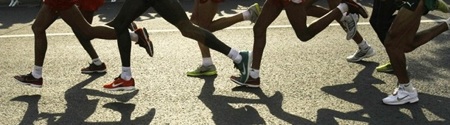
It's a mistake to go too light on running shoes since cushioning will be compromised. So I was a bit surprised to find it as soft as the supercushy Vomeros. That feeling comes solely from the new lightweight foam used. There is no cushioning whatever in the upper: no liner, no padded tongue. It's minimalist to the point of being almost transparent and as a result its weight is about half the Vomeros.

Of course, that meant I had to buy it as well. (The fit is a little different, I had to move up half-a-size.)

[L to R: Lunar Racer+, Vomero 3 and Vomero 2+]

As a recovering weight-weenie cyclist, I also find it surprising that at a list price of $100 it actually costs less than the heavier shoe. When it comes to cycling componentry, you always pay more for weight reduction, sometimes way more for a ridiculously insignificant percentage decrease.

Saving the weight of one shoe (0.33 kg) seems pretty significant until you realize I weigh somewhere in the range of 68-69 kg at present. In other words, I seriously doubt I will be able to see the effect of the shoe in terms of my running speed. And in any case, I'm not exactly elite athlete material.

Adding the Lunar Racer+ to my shoe collection represents a deeply embarassing personal statement of dedication and commitment to completing my run workouts come what may (modulo injuries) this semester. Shelling out another $100 on an event-only shoe (or at most a once-a-week-speedwork shoe) doesn't make practical sense.

And somewhat irrationally, I won't feel like lacing them up unless I feel I've earned my right to use them. And they won't make any measurable difference anyway. Go figure.


Monday, October 20, 2008

Running in San Francisco


Recently, I happened to be in San Francisco for a few days.

{Pic courtesy of Duffy Gillman]

What's the best way to see the city in a hurry?

One might think of their iconic cable cars, perhaps BART or buses.

Instead, I ran.

In two runs, I covered about 11 miles.
Both days were sunny.

There's definitely a runner's high to be felt pounding along the waterfront along San Francisco Bay and up and down those steep hills with great views.

Wish I could've stayed longer and gone further, e.g. do the Golden Gate bridge.

Routes

Starting out each time from near Union Square along Market St out to the Ferry House.
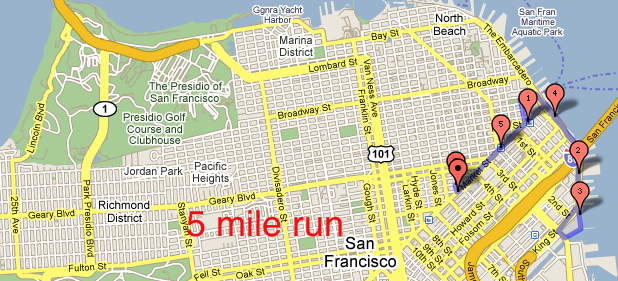
Then Run #1: turning right to head south along the Embarcadero looping around the SF Giants' AT&T Baseball Park and back. About 5.5 miles and mostly flat. (Found this route on the SFRRC's website.)

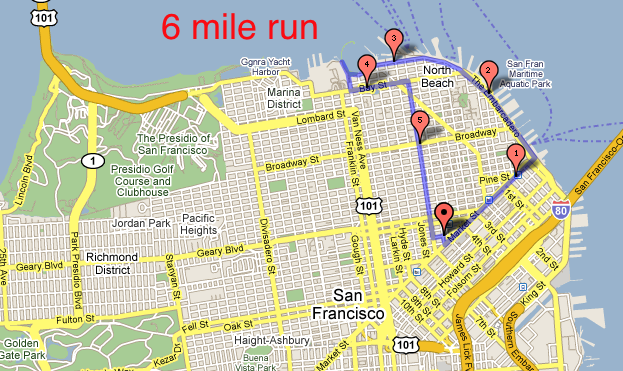
Or Run #2: turn left to head north along the Embarcadero to Fort Mason, but coming back along Taylor St over Russian Hill (with a view of Telegraph Hill and the Coit Tower to the left) and then Nob Hill. About 6 miles.

Bonus

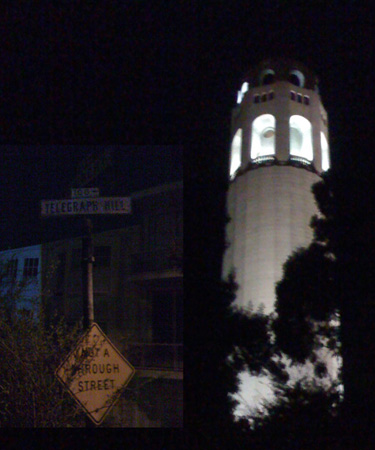
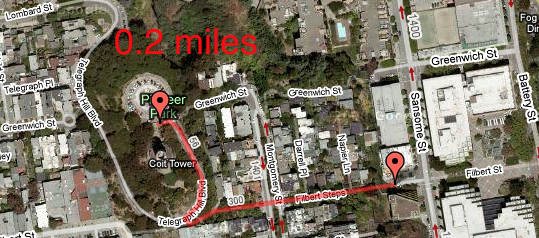
One evening after dinner, I had the chance to cross the Levi Plaza and run up the Filbert Steps to the Coit tower in street clothing and shoes.

I felt like passing out but managed to snap two pictures with my iPhone camera (below).

Only two tenths of a mile according to Google Maps. Who needs a stairmaster and gym when you have this?

Sunday, September 7, 2008

SRAM Red 11-26 cassette

I used to be really into getting the latest and greatest components for my road bike. It was kind of a hobby of mine. An expression of my love for cycling as it were.

Now, I simply ride my bike and enjoy the scenery.
(See last entry on the matter here.)

However, recognizing that I no longer had the legs to ride a 23T up Mt Lemmon (even on a compact crank setup), I installed an SRAM Red 11-26 cassette this weekend. And it immediately took me back to my bike porn days.

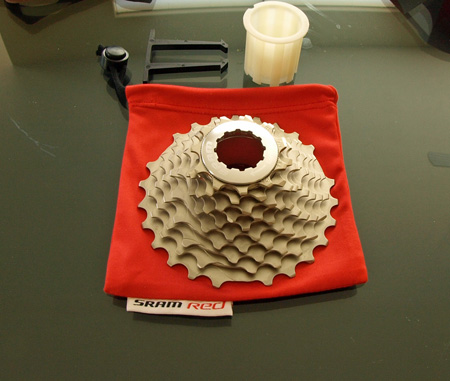
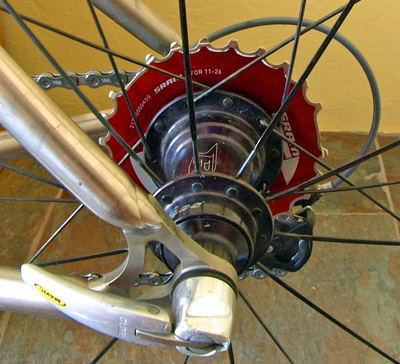
I grabbed my DSLR to illustrate why before it got all greasy and encrusted with dirt:

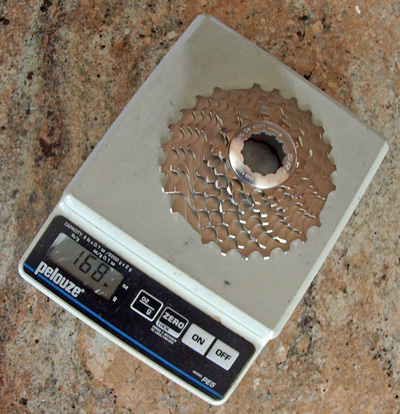
Not only that it's a specially-made 10-speed steel cassette that is hollowed out to the point it weighs just 168g as measured on my scale (see below) but the fact that it comes in a (function-free) soft red bag is proof-positive this is a serious piece of chi-chi componentry.

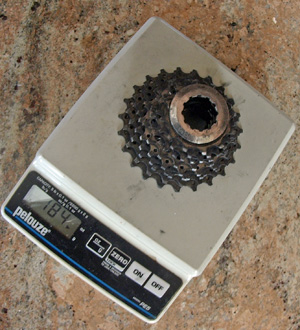
Lightweight backpackers can probably appreciate that 168g is amazing light for all steel construction, especially when compared to a narrower range Shimano Dura-Ace 12-23 cassette with a mix of steel and titanium cogs riding on alloy carriers that weighs 184g on the same scale:

Functionality-wise, it's a direct drop in. Only sign I have it is the relatively subtle red plate on the back:

It works fine with the Shimano Dura-Ace chain. And shifts beautifully with a (satisfying?) clunk.

The weight savings is several orders of magnitude below any measureable threshold since I'm weighing in at 70kg plus. And in any case, I need a slightly longer (and heavier) chain.

The 26T, however, is the reason why I bought it. My legs can appreciate the slightly over 10% easier climbing it brings at the same cadence.

One thousand miles (and Griffin iTrip Autopilot review)

One thousand miles. To be a prisoner inside a steel cage for 14 hours with a singular focus on piling up the miles, listening to tunes.

Driving from Tucson to Boston back in January took me just over 4 days. I averaged a very comfortable 650 miles a day.
(See my blog entry and mile/fuel stats here.)

So why a thousand miles?

Well, on my return from Boston to Tucson, I lost a rear tire to debris and a travel day due to I-81 southbound being completely closed.

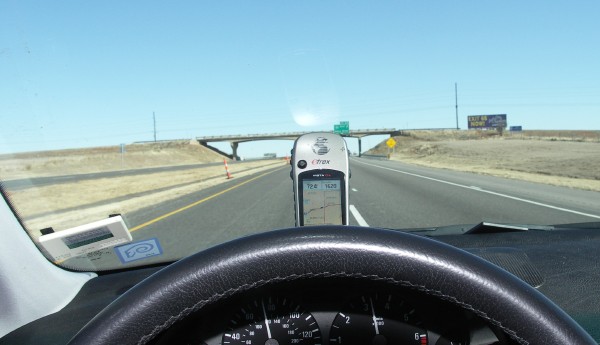
With the beginning of the semester approaching, I had to make up time. Heading west from just east of Little Rock AR after breakfast I managed to make it all the way to Las Cruces NM in 14 hours for an average of nearly 72 mph including stops.

Yup. A cool thousand, including all the way across Texas:

1000 miles and 14 hours wouldn't have been realistic parameters in the crowded Northeast but in the vast emptiness that is Texas, one can just set the cruise control and listen to music. Well, there was heavy stop-and-go traffic going through Dallas but that was the only trouble spot I encountered.

Speaking of music, I used my iPhone 3G for both iPod functionality and GPS navigation on this trip. Mounting options include simply placing the phone sideways in the instrument binnacle (displaying GPS-enabled Google maps):

or using a generic vent mount (from aWalmart Supercenter) - here in iPod mode:

Compare this to what I did with my Garmin Etrex back in January here.)

To interface with the aux input-free Harman Kardon sound system in my car and to feed the battery-hungry beast that is the iPhone 3G, I used a Griffin iTrip Autopilot FM radio transmitter and charger that I purchased at the Cambridgeside Apple store for this purpose. A vital accessory on a 14 hour day.

I was pretty happy with the FM transmitter part because the iTrip Autopilot can be set in extended FM frequency range (76.0-108.0MHz) for international (i.e. non-US) use. Furthermore, my car was sold in multiple markets with the same radio/cd player. This means the radio can be rebooted in Japan FM mode (76.0-90.0 MHz) via the service menu and tuned down to an empty 76.0MHz here in the US. The sound quality is markedly better than in the regular noisy FM band here.
(For those of you who are not familiar with car radio FM transmitters, settling on an unoccupied, i.e. interference-free, frequency on FM can be a rather frustrating experience.)

BMW Business CD service menu access: turn radio off then on. Hold down the m button for ten seconds, +/- buttons to find Area, preset 1 to flip through the areas, select Japan, then +/- reboots.
Griffin iTrip Autopilot extended frequency range: hold down center key until logo shifts position.

Unfortunately, I was less happy with the charging function of the iTrip Autopilot. To my dismay, my iPhone actually discharged despite being plugged in!

I opened a ticket with Griffin Tech Support:
[ME] Unfortunately, I've discovered there is a big problem with the itrip autopilot. Sometimes it doesn't give enough power to the iPhone 3G, esp. when the maps/gps is running and the ipod functions are playing to charge the iphone 3g. Worse still, when these functions are running, the iphone 3g actually discharges! As a result, i get warnings that it's down to 20% power etc. when I started with a full charge before plugging it into the itrip autopilot.
The reply?
[Technical Support]This will happen if the iPhone is running multiple applications like you are on your trip. If you dim the iPhone screen a little, this will help. A good analogy would be... you're burning gas faster than you can fill up your tank. Does that make sense?
Follow-up:
[ME]but I thought you'd have a version with a beefier power supply for the iphone 3g. It's wierd to plug it in and end up with a discharged battery. Like if I plug in my macbook and run lots of applications, I don't expect the batttery to run down.
I gave up after the next reply:
[Technical Support]True, but its much different when you're talking about AC compared to DC. Thank you.
Well,in my opinion this is a product defect. All I have to say is watch out if you buy the iTrip Autopilot: you may end up with a discharged iPhone 3G because the power supply is too wimpy and there is no warning of this anywhere in the product packaging.

Monday, August 25, 2008

Another tri-state area

When one hear the term Tri-State Area or Region, I believe most people think of the well-known New York-New Jersey-Connecticut (NY-NJ-CT) tri-state region. Well, at least the two are synonymous for me probably because I've spent ten years living in Jersey.

Of course, other tri-state areas exist but I was astonished to discover there are actually as many as 38 officially-marked "tripoints" in the United States. Moreover, the NY-NJ-CT tri-state region does not actually possess a tripoint. (See this authoritative Wikipedia entry.)

Last week, I visited one of these real tripoints on my drive home from Boston to Tucson. As seen on my iPhone 3G map display, this is where Virgina, Tennessee and Kentucky meet. (The blue GPS blob marks the point where I was standing.)

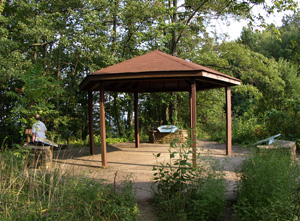
Although it's a nice 1.2 mile walk up to the Tri-State Peak located inside the Cumberland Gap National Historical Park, it's a bit of a disappointing hike: trees and other vegetation block any chance of a scenic view.

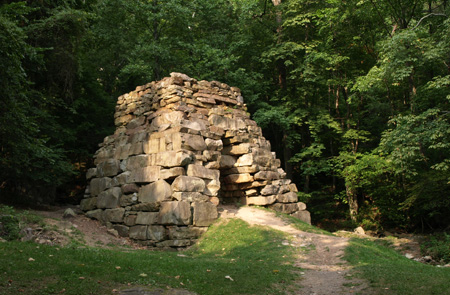
Nestled in a clearing lower down, however, is the surprisingly photogenic (almost Mayan temple-like) remains of an Iron Furnace:

Given my recent interest in 360° spherical panorama photography (see recent blog entry tech and subjects: The Stata Center and The Getty Museum Los Angeles), I couldn't resist the opportunity to make a panorama at this spot. Download here. (Warning: 12.1MB file. You can view this using Quicktime player.)

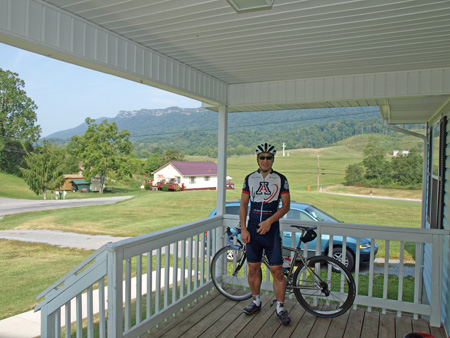
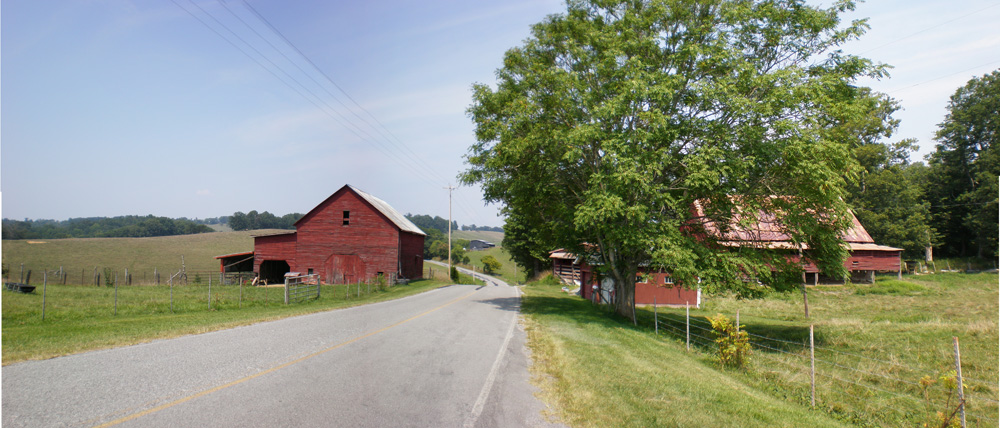
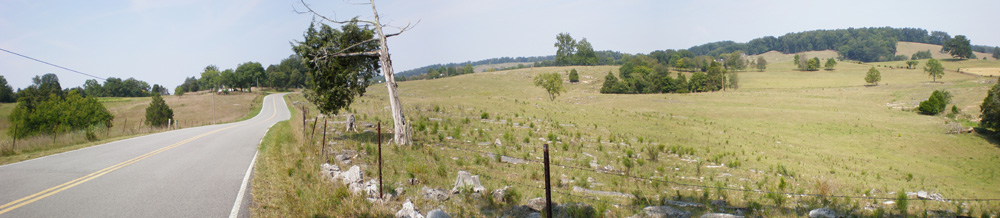
Anyway, I was here to visit my good friend Jim Montgomery who has recently moved to this hilly and very rural - let's just say dining-opportunity-limited - corner of southwestern Virigina bordering Kentucky and Tennessee. The upsides are the gorgeous scenery and almost empty roads in pristine condition (a consequence of the lack of real winter, population and truck traffic I reckon). In short, a perfect "secret" location for bike training. On Jim's porch:

jim led me on a perfect 25 mile training loop from his home in Rose Hill VA with about 1700 ft of climbing. The GPS tracklog recorded on my Garmin eTrex Vista Cx:

I wish I had more time to explore the region on my bike but the start of a new semester in Tucson cannot be delayed. For example, the Cumberland Gap tunnel "crosses" - or is it also appropriate to use the semantically-bleached terms "bridge" or "thread"? - the mountain ridge that can be seen in the background. In particular, I'd like to try the (presumably abandoned) mountain road it replaced. Another Wikipedia entry states:
The tunnel replaced a 2.3-mile (3.7 km) stretch of U.S. 25E between Middlesboro, Kentucky and Cumberland Gap, Tennessee that became known as "Massacre Mountain" due to the large number of travelers killed on the twisting mountain road over the Cumberland Gap pass.
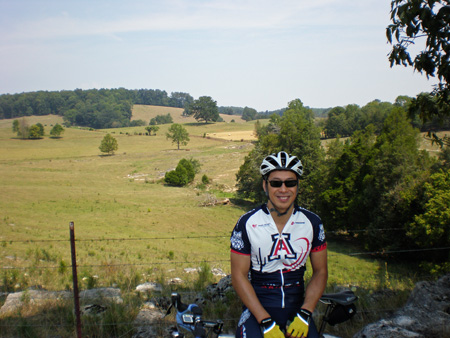
Anyway, some pictures from the ride are shown below - I'd have to rate the route as equal or better to my favorite Valley Forge PA area hill route I used to ride but without the traffic and with far better roads.


Monday, August 4, 2008

Swim milestone for real

I keep trying but I truly suck as a swimmer. (Previous entry: swim: freestyle.)

Finally, I feel I've achieved something tangible in the pool: I mile continuous. To help you understand why I'm so enormously proud of this tiny achievement, here is an underwater picture taken with my Olympus 720SW:

(Link to the video clip at the end of this entry.)

I am as horizontal as I can get. But my entire body is under water! I'm a sinker. As a sinker, I have to overcome a lot of extra water resistance. (Compare with a normal swimmer - who, when lying flat, has their butt and head poking up above water. Obviously, water resistance trumps air resistance.)

Another efficiency disadvantage of having to swim underwater (instead of normally) is that to be able to breathe I need to over-rotate and tilt my head a bit to get my mouth above water to suck in air. Basically looking at the ceiling instead of horizontally at the divider.

I only learned to swim a few years and have had trouble banging out the laps ever since.

Technique-wise, I've benefited enormously from advice since my first adult-learn-to-swim class. But progress has been painful slow. Definitely my worst "sport".

Some chronology of my sorry battle with the pool:
  1. Needing to breathe every half stroke. Basically thrashing.
  2. Swim noseclip era.
    Embarassed to say it took a while until I could swim without it.
  3. Wearing neoprene long shorts to aid buoyancy.
    Hey, I was desperate!
    Managed my first 20 laps this way. Only years later, could I manage 20 laps unaided.
  4. Bilateral breathing. Every 1.5 strokes.
    A breakthrough. No more thrashing but limited me to 100 meters max at a time before I ran out of breath.
    Managed my first sorta "swimmer's mile" this way with breathing breaks every 100 meters. (See previous post swim milestone.)
    Doesn't really count...
  5. Breathing on the right side only.
    Another breathrough. 20 laps unaided finally.
That brings me to this past weekend. I finally achieved my milestone, i.e. 1 mile continuously. I swam 38 laps (76 lengths) or 1900 yds sans breaks. A mile is 1760 yds but I did extra to make sure I didn't miscount.

It was done in a 25 yard pool though. (Theoretically, I should be able to repeat the feat in the main 50 meter pool as well.)

Here is the previously mentioned clip from which the stlll was taken. (Warning: 640x480, 27.5MB.)

My next goal? To swim 1 mile without having the lifeguard come around and ask me if I'm okay :-)

Tuesday, July 29, 2008

iPhone 3G experience

I bought an iPhone 3G this morning to replace my broken Verizon Wireless (VZW) Motorola E-815.

Here it is sitting next to a 9.5mm 2.5" 320GB (laptop) portable hard drive and my defunct Motorola phone.

I ported my number over from Verizon. It took a few hours and a support call to ATT Wireless. I've been a Verizon customer for probably 15 years plus. So long Verizon.

I checked the iPhone 3G availability table last night. I wanted the 16GB model in black.

Felt it was a bit ridiculous to be standing in line at 8:30am at the Cambridgeside Apple store just to buy a phone that wasn't even on sale. The lady behind me in the line reassured me it was okay: nothing to be embarassed about, nobody's around in the mall this early. She was waiting in line to get the iPhone 3G 16GB in black for her husband. Same one I had my eye on. I wasn't the only one in line wondering just how many they had left.

Anyway, I got the phone around 9:30am. ATT Wireless handled the porting, without me having to contact VZW directly, once I gave them my VZW account and SS numbers. But I didn't get the "port completed" text message on my new phone (allowing me to receive calls) until noon. When I called ATT at 11:30am, I was told the delay was because I hadn't turned off my old phone.

Setup

Since I had a .mac (now MobileMe) account already, the setup was incredibly slick. It grabbed my contact information, iCal, Mail server settings and browser bookmarks sans intervention. I also synced my iTunes library. One reason I paid more for the 16GB model was that it could store more albums than my 8GB (Gen2) Nano.

I get all my email just like on my Macbook. Viewable PDF attachments and everything. It's set up to Push sync rather than poll with my .mac mail but the other two mail servers I use at Arizona and MIT are Fetch (poll) only.

If I add a new event to my calendar it's transparently and automaticaly synchronized with my computer. For appointments, this is handy and great.

The level of integration from just these two features make the phone truly useful for me. The $299+tax price tag means it's not inexpensive by any means but the humble cellphone has taken a huge step in usability for me.

There are other bells and whistles. As far as I can tell, A-GPS is cool and fast too. I wonder if it's better than my little Garmin Etrex Vista CX (which has all the roads in the US preloaded).

The iPhone 3G experience with ATT isn't completely seamless though. For example, they sent me an email:

Unfortunately, you can't redeem the ringtone coupon since the iPhone is not a listed phone on ATT mediamall! (That saved me from downloading Abba's Dancing Queen as my ringtone.)

I called ATT to point this out. They gave me a $2.49 credit on the account to facilitate buying a ringtone on iTunes.

Unfortunately, since I'm in Boston for a few more weeks, I can't check the ATT Wireless coverage back in Tucson. That's a risk I have to take. From the maps below, I'm hoping it's as good as VZW. Nothing would be more frustrating than a state-of-the-art phone that works everywhere except between home and work.

Voice coverage (darker is better):

3G data coverage (in blue):